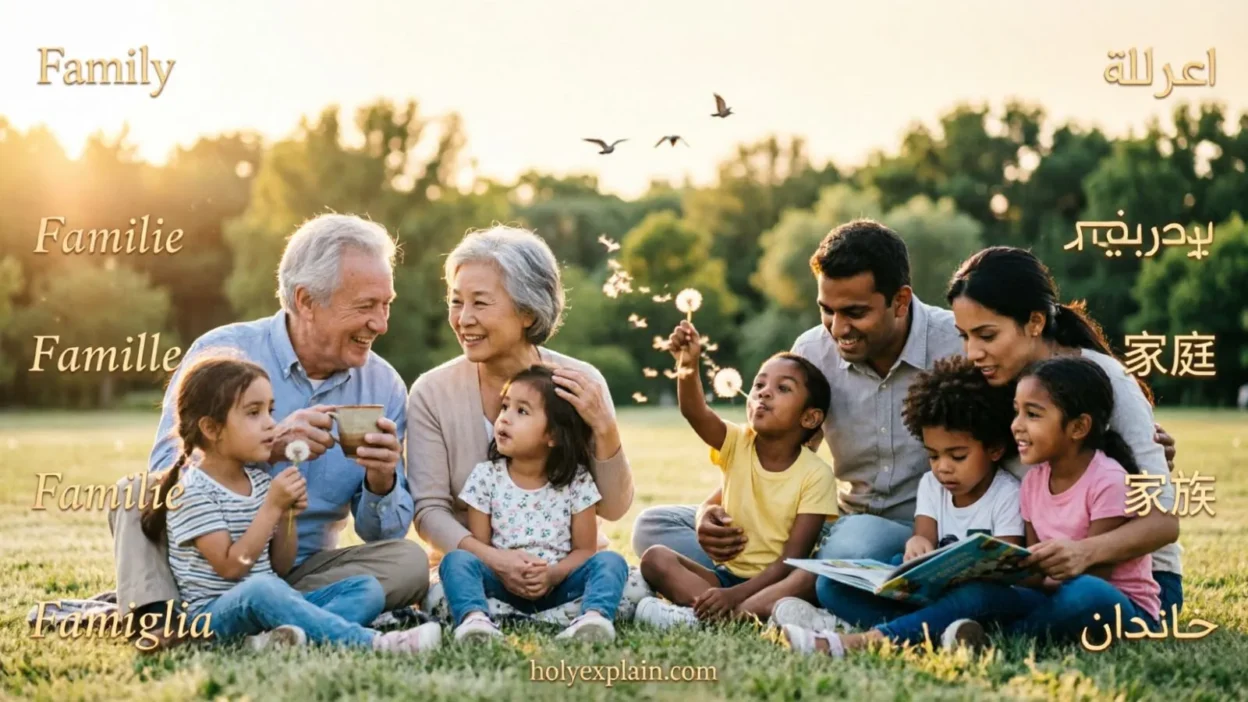
Family is one of the most important concepts in every culture. If it refers to parents, children, relatives, or loved ones, the idea of family connects people across countries and languages.
Learning how to say “family” in different languages is a great way to explore cultures, improve language skills, and communicate with people from around the world.
In this guide, you’ll discover how to say family in different languages, along with pronunciations, meanings, and examples.
If you’re a traveler, student, language learner, or simply curious about world languages, this list will help you understand the global importance of family.
Family in Different Languages
1. Family in Spanish
Phrase: Familia
Pronunciation: Fah-MEE-lee-ah
Meaning: Family
Example: Mi familia es muy importante para mí.
Explanation: Familia is commonly used throughout Spanish-speaking countries to refer to relatives and loved ones.
2. Family in French
Phrase: Famille
Pronunciation: Fah-MEE-yuh
Meaning: Family
Example: Ma famille habite en France.
Explanation: Famille is a central word in French culture, emphasizing strong family bonds.
3. Family in German
Phrase: Familie
Pronunciation: Fah-MEE-lee-uh
Meaning: Family
Example: Meine Familie lebt in Berlin.
Explanation: The German word closely resembles its English counterpart.
4. Family in Italian
Phrase: Famiglia
Pronunciation: Fah-MEEL-yah
Meaning: Family
Example: La mia famiglia è molto grande.
Explanation: Family plays a major role in Italian traditions and social life.
5. Family in Portuguese
Phrase: Família
Pronunciation: Fah-MEE-lee-ah
Meaning: Family
Example: Minha família mora no Brasil.
Explanation: Used in Portugal, Brazil, and other Portuguese-speaking regions.
6. Family in Dutch
Phrase: Familie
Pronunciation: Fah-MEE-lee
Meaning: Family
Example: Mijn familie woont hier.
Explanation: Dutch speakers use this term for immediate and extended relatives.
7. Family in Russian
Phrase: Семья (Semya)
Pronunciation: Sem-YA
Meaning: Family
Example: Моя семья счастлива.
Explanation: Family is highly valued in Russian culture.
8. Family in Ukrainian
Phrase: Сім’я (Simya)
Pronunciation: Seem-YA
Meaning: Family
Example: Моя сім’я дуже дружна.
Explanation: Refers to both immediate and extended family members.
9. Family in Polish
Phrase: Rodzina
Pronunciation: Roh-DZEE-nah
Meaning: Family
Example: Moja rodzina jest duża.
Explanation: A commonly used term in Polish households.
10. Family in Czech
Phrase: Rodina
Pronunciation: Roh-DEE-nah
Meaning: Family
Example: Moje rodina je úžasná.
Explanation: Similar to related Slavic languages.
11. Family in Greek
Phrase: Οικογένεια
Pronunciation: Ee-ko-YEH-nee-ah
Meaning: Family
Example: Η οικογένειά μου είναι μεγάλη.
Explanation: Family is considered a foundation of Greek society.
12. Family in Turkish
Phrase: Aile
Pronunciation: Ah-ee-LEH
Meaning: Family
Example: Ailem benim için çok önemli.
Explanation: Family relationships are highly respected in Turkish culture.
13. Family in Arabic
Phrase: عائلة
Pronunciation: Aa-ee-lah
Meaning: Family
Example: عائلتي كبيرة.
Explanation: Family ties are deeply rooted in Arab communities.
14. Family in Hebrew
Phrase: משפחה
Pronunciation: Mish-pah-HAH
Meaning: Family
Example: המשפחה שלי נפלאה.
Explanation: A key word in everyday Hebrew conversations.
15. Family in Persian
Phrase: خانواده
Pronunciation: Kha-ne-va-deh
Meaning: Family
Example: خانواده من دوست داشتنی است.
Explanation: Family is central to Persian culture and traditions.
16. Family in Hindi
Phrase: परिवार
Pronunciation: Pari-vaar
Meaning: Family
Example: मेरा परिवार बहुत प्यारा है।
Explanation: Widely used across India.
17. Family in Urdu
Phrase: خاندان
Pronunciation: Khaan-daan
Meaning: Family
Example: میرا خاندان بہت اچھا ہے۔
Explanation: Refers to family, lineage, and relatives.
18. Family in Bengali
Phrase: পরিবার
Pronunciation: Pori-bar
Meaning: Family
Example: আমার পরিবার খুব বড়।
Explanation: Commonly used in Bangladesh and West Bengal.
19. Family in Punjabi
Phrase: ਪਰਿਵਾਰ
Pronunciation: Pari-vaar
Meaning: Family
Example: ਮੇਰਾ ਪਰਿਵਾਰ ਮੇਰੀ ਤਾਕਤ ਹੈ।
Explanation: Represents family and close relatives.
20. Family in Gujarati
Phrase: પરિવાર
Pronunciation: Pari-vaar
Meaning: Family
Example: મારું પરિવાર ખુશ છે।
Explanation: A frequently used word in Gujarati-speaking regions.
21. Family in Marathi
Phrase: कुटुंब
Pronunciation: Ku-tumb
Meaning: Family
Example: माझे कुटुंब मोठे आहे।
Explanation: Refers to a household or family unit.
22. Family in Tamil
Phrase: குடும்பம்
Pronunciation: Ku-dum-bam
Meaning: Family
Example: என் குடும்பம் எனக்கு முக்கியம்.
Explanation: An important term in Tamil culture.
23. Family in Telugu
Phrase: కుటుంబం
Pronunciation: Ku-tu-mbam
Meaning: Family
Example: నా కుటుంబం చాలా మంచిది.
Explanation: Commonly used throughout Telugu-speaking communities.
24. Family in Kannada
Phrase: ಕುಟುಂಬ
Pronunciation: Ku-tum-ba
Meaning: Family
Example: ನನ್ನ ಕುಟುಂಬ ನನ್ನ ಹೆಮ್ಮೆ.
Explanation: Indicates family members and household relations.
25. Family in Malayalam
Phrase: കുടുംബം
Pronunciation: Ku-dum-bam
Meaning: Family
Example: എന്റെ കുടുംബം സന്തോഷവാനാണ്.
Explanation: Widely used in Kerala.
26. Family in Chinese
Phrase: 家庭
Pronunciation: Jia Ting
Meaning: Family
Example: 我的家庭很幸福。
Explanation: One of the most common Chinese words for family.
27. Family in Japanese
Phrase: 家族
Pronunciation: Ka-zoku
Meaning: Family
Example: 私の家族は優しいです。
Explanation: Refers to immediate family members.
28. Family in Korean
Phrase: 가족
Pronunciation: Ga-jok
Meaning: Family
Example: 우리 가족은 행복합니다.
Explanation: A frequently used word in Korean society.
29. Family in Thai
Phrase: ครอบครัว
Pronunciation: Krop-Krua
Meaning: Family
Example: ครอบครัวของฉันอบอุ่นมาก
Explanation: Family values are highly respected in Thailand.
30. Family in Vietnamese
Phrase: Gia đình
Pronunciation: Zya Dinh
Meaning: Family
Example: Gia đình tôi rất hạnh phúc.
Explanation: Family relationships are central to Vietnamese culture.
Why Learning Family in Different Languages Is Important
Learning how to say family in different languages helps build cultural awareness and strengthens communication skills. Since family is a universal concept, knowing this word in multiple languages can help travelers, students, and professionals connect with people more effectively.
Understanding family-related vocabulary also improves language learning because it introduces common words used in daily conversations. It creates a stronger foundation for learning new languages and understanding different cultures.
Practical Tips for Learning Family Words in Multiple Languages
Use Flashcards
Create flashcards with the word, pronunciation, and meaning to improve memory retention.
Practice Daily
Repeat a few words every day to build familiarity and confidence.
Watch Native Content
Movies, TV shows, and videos help you hear natural pronunciation.
Learn Related Vocabulary
Study words such as mother, father, brother, sister, and relatives alongside family.
Use Language Apps
Language-learning apps can help reinforce pronunciation and vocabulary through repetition.
Conclusion
The word family exists in every language because family is a fundamental part of human life.
Learning how to say family in different languages not only expands your vocabulary but also deepens your appreciation for cultures around the world.
If you’re learning a new language, traveling abroad, or exploring global traditions, these translations can help you connect with people on a more meaningful level.
FAQs:
1. How do you say family in different languages?
Family can be translated as Familia (Spanish), Famille (French), Familie (German), 家族 (Japanese), and many other terms depending on the language.
2. What is the most common word for family worldwide?
There is no single global word, but many languages use similar terms derived from Latin roots, such as familia, famille, and famiglia.
3. Why is learning family vocabulary important?
Family vocabulary is frequently used in conversations and helps language learners discuss personal relationships and daily life.
4. How do you say family in Asian languages?
Examples include 家庭 in Chinese, 家族 in Japanese, 가족 in Korean, and परिवार in Hindi.
5. Is family an important concept in all cultures?
Yes. Family is considered one of the most important social units across cultures and societies worldwide.