
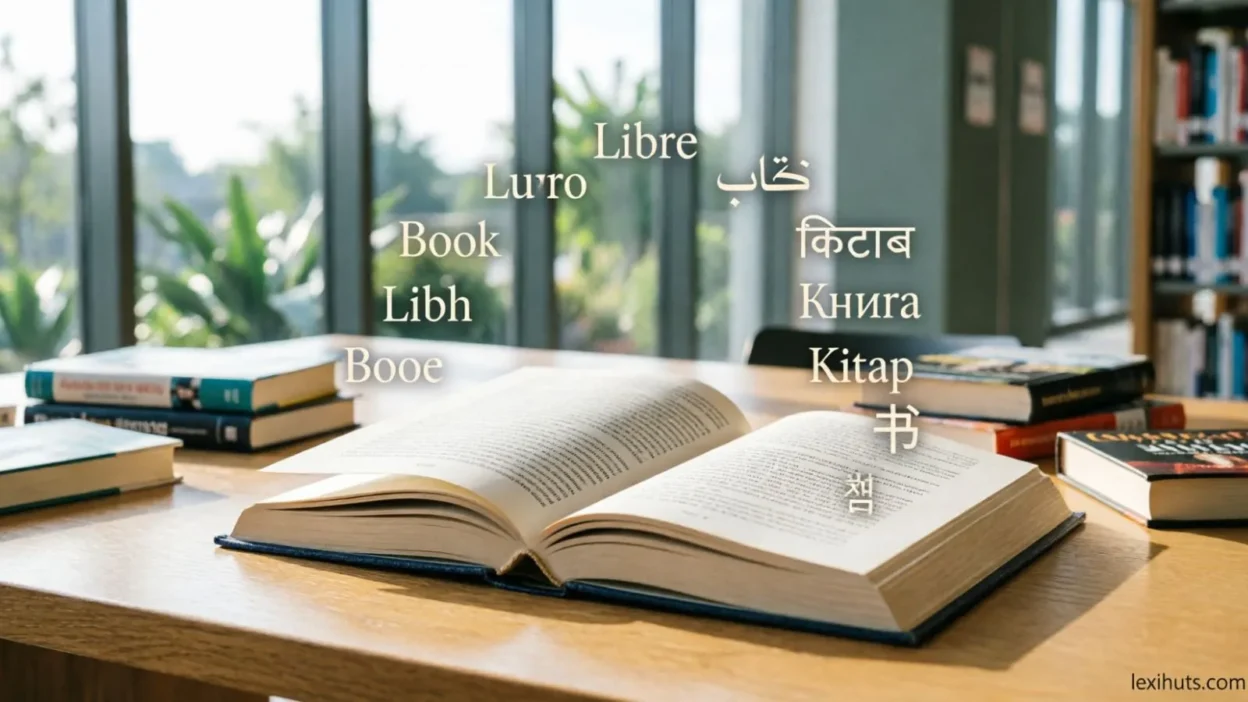
Books are one of the most important tools for learning, entertainment, culture, and communication.
If you are a traveler, language learner, student, or simply curious about world languages, knowing how to say “book” in different languages can be both educational and fascinating.
In this guide, you’ll discover how the word “book” is translated across many languages worldwide.
You’ll also learn pronunciation tips, meanings, and examples that can help you expand your vocabulary and better understand global cultures.
Why Learn the Word “Book” in Different Languages?
The word “book” is commonly used in everyday conversations. Learning it in multiple languages can help you:
- Improve language-learning skills
- Communicate while traveling
- Understand cultural differences
- Expand your multilingual vocabulary
- Enhance translation and educational knowledge
How to Say Book in Different Languages
1. Book in Spanish
Phrase: Libro
Pronunciation: LEE-bro
Meaning: A written or printed work consisting of pages bound together.
Example: Estoy leyendo un libro. (I am reading a book.)
2. Book in French
Phrase: Livre
Pronunciation: LEE-vruh
Meaning: The French word for book.
Example: J’aime lire un livre. (I like reading a book.)
3. Book in German
Phrase: Buch
Pronunciation: BOOKH
Meaning: A book or written publication.
Example: Ich lese ein Buch.
4. Book in Italian
Phrase: Libro
Pronunciation: LEE-bro
Meaning: A book used for reading or study.
Example: Questo libro è interessante.
5. Book in Portuguese
Phrase: Livro
Pronunciation: LEE-vro
Meaning: A written work or publication.
Example: Estou lendo um livro.
6. Book in Dutch
Phrase: Boek
Pronunciation: BOOK
Meaning: Book or publication.
Example: Ik lees een boek.
7. Book in Russian
Phrase: Книга (Kniga)
Pronunciation: KNEE-ga
Meaning: A collection of written pages.
Example: Я читаю книгу.
8. Book in Ukrainian
Phrase: Книга (Knyha)
Pronunciation: KNI-ha
Meaning: Written publication.
Example: Я читаю книгу.
9. Book in Polish
Phrase: Książka
Pronunciation: KSHONZH-ka
Meaning: A book or literary work.
Example: Czytam książkę.
10. Book in Czech
Phrase: Kniha
Pronunciation: KNEE-ha
Meaning: Book.
Example: Čtu knihu.
11. Book in Slovak
Phrase: Kniha
Pronunciation: KNEE-ha
Meaning: Printed or digital book.
12. Book in Hungarian
Phrase: Könyv
Pronunciation: KURNYV
Meaning: Book.
13. Book in Romanian
Phrase: Carte
Pronunciation: KAR-te
Meaning: Book or written publication.
14. Book in Greek
Phrase: Βιβλίο (Vivlio)
Pronunciation: VEE-vlee-o
Meaning: Book.
15. Book in Turkish
Phrase: Kitap
Pronunciation: KEE-tap
Meaning: Book.
16. Book in Arabic
Phrase: كتاب (Kitab)
Pronunciation: Kee-TAB
Meaning: Book, text, or written document.
17. Book in Hebrew
Phrase: ספר (Sefer)
Pronunciation: SEH-fer
Meaning: Book.
18. Book in Persian
Phrase: کتاب (Ketab)
Pronunciation: Keh-TAB
Meaning: Written book.
19. Book in Hindi
Phrase: किताब (Kitaab)
Pronunciation: Kee-TAAB
Meaning: Book.
20. Book in Urdu
Phrase: کتاب (Kitab)
Pronunciation: Kee-TAB
Meaning: Book.
21. Book in Punjabi
Phrase: ਕਿਤਾਬ (Kitaab)
Pronunciation: Kee-TAAB
Meaning: Book.
22. Book in Bengali
Phrase: বই (Boi)
Pronunciation: BOY
Meaning: Book.
23. Book in Gujarati
Phrase: પુસ્તક (Pustak)
Pronunciation: POOS-tak
Meaning: Book.
24. Book in Marathi
Phrase: पुस्तक (Pustak)
Pronunciation: POOS-tak
Meaning: Book.
25. Book in Tamil
Phrase: புத்தகம் (Puthagam)
Pronunciation: POO-tha-gam
Meaning: Book.
26. Book in Telugu
Phrase: పుస్తకం (Pustakam)
Pronunciation: POOS-ta-kam
Meaning: Book.
27. Book in Kannada
Phrase: ಪುಸ್ತಕ (Pustaka)
Pronunciation: POOS-ta-ka
Meaning: Book.
28. Book in Malayalam
Phrase: പുസ്തകം (Pusthakam)
Pronunciation: POOS-tha-kam
Meaning: Book.
29. Book in Chinese (Mandarin)
Phrase: 书 (Shū)
Pronunciation: SHOO
Meaning: Book.
Example: 我喜欢看书。 (I like reading books.)
30. Book in Japanese
Phrase: 本 (Hon)
Pronunciation: HONE
Meaning: Book.
31. Book in Korean
Phrase: 책 (Chaek)
Pronunciation: CHEK
Meaning: Book.
32. Book in Thai
Phrase: หนังสือ (Nang Sue)
Pronunciation: NANG-SUE
Meaning: Book.
33. Book in Vietnamese
Phrase: Sách
Pronunciation: SAK
Meaning: Book.
34. Book in Indonesian
Phrase: Buku
Pronunciation: BOO-koo
Meaning: Book.
35. Book in Malay
Phrase: Buku
Pronunciation: BOO-koo
Meaning: Book.
36. Book in Filipino
Phrase: Aklat
Pronunciation: AK-lat
Meaning: Book.
37. Book in Swahili
Phrase: Kitabu
Pronunciation: Kee-TA-boo
Meaning: Book.
38. Book in Afrikaans
Phrase: Boek
Pronunciation: BOOK
Meaning: Book.
39. Book in Zulu
Phrase: Incwadi
Pronunciation: In-KWA-dee
Meaning: Book.
40. Book in Somali
Phrase: Buug
Pronunciation: BOOG
Meaning: Book.
41. Book in Finnish
Phrase: Kirja
Pronunciation: KEER-ya
Meaning: Book.
42. Book in Swedish
Phrase: Bok
Pronunciation: BOOK
Meaning: Book.
43. Book in Norwegian
Phrase: Bok
Pronunciation: BOOK
Meaning: Book.
44. Book in Danish
Phrase: Bog
Pronunciation: BOH
Meaning: Book.
45. Book in Icelandic
Phrase: Bók
Pronunciation: BOKE
Meaning: Book.
46. Book in Irish
Phrase: Leabhar
Pronunciation: LYOW-er
Meaning: Book.
47. Book in Welsh
Phrase: Llyfr
Pronunciation: HLUV-er
Meaning: Book.
48. Book in Basque
Phrase: Liburua
Pronunciation: Lee-boo-ROO-a
Meaning: Book.
49. Book in Esperanto
Phrase: Libro
Pronunciation: LEE-bro
Meaning: Book.
50. Book in Latin
Phrase: Liber
Pronunciation: LEE-ber
Meaning: Book.
Why Learning “Book” in Different Languages Is Important
Knowing how to say common words such as “book” in different languages helps build a foundation for language learning. It also improves communication skills when interacting with people from different countries and cultures.
Students, travelers, teachers, translators, and language enthusiasts often begin learning essential vocabulary words like “book” because they appear frequently in daily life. Understanding these translations can make learning a new language easier and more enjoyable.
Useful Tips for Remembering Book in Different Languages
Focus on Similar Words
Many languages share similar words for book. For example, Libro appears in Spanish, Italian, and Esperanto, making it easier to remember.
Practice Pronunciation Daily
Say each word aloud several times. Hearing and speaking new vocabulary improves retention.
Use Flashcards
Create physical or digital flashcards with the language on one side and the translation on the other.
Learn Through Reading
Read simple books or children’s stories in different languages to reinforce vocabulary naturally.
Group Languages by Region
Learning related languages together can help identify patterns and similarities in vocabulary.
Conclusion
Learning how to say “book” in different languages is a simple yet powerful way to expand your global vocabulary.
From Libro in Spanish to Shū in Chinese and Kitab in Arabic, each translation reflects the richness of language and culture around the world.
If you’re traveling, studying, or exploring new languages for fun, these translations provide a useful starting point for multilingual communication.
FAQs:
1. How do you say book in Spanish?
Book in Spanish is “Libro.”
2. What is the Arabic word for book?
The Arabic word for book is “كتاب” (Kitab).
3. How do you say book in Japanese?
In Japanese, book is “本” (Hon).
4. What is the Chinese word for book?
The Chinese (Mandarin) word for book is “书” (Shū).
5. Why should I learn common words in different languages?
Learning common words improves communication, helps with travel, and makes language learning easier and more enjoyable.