
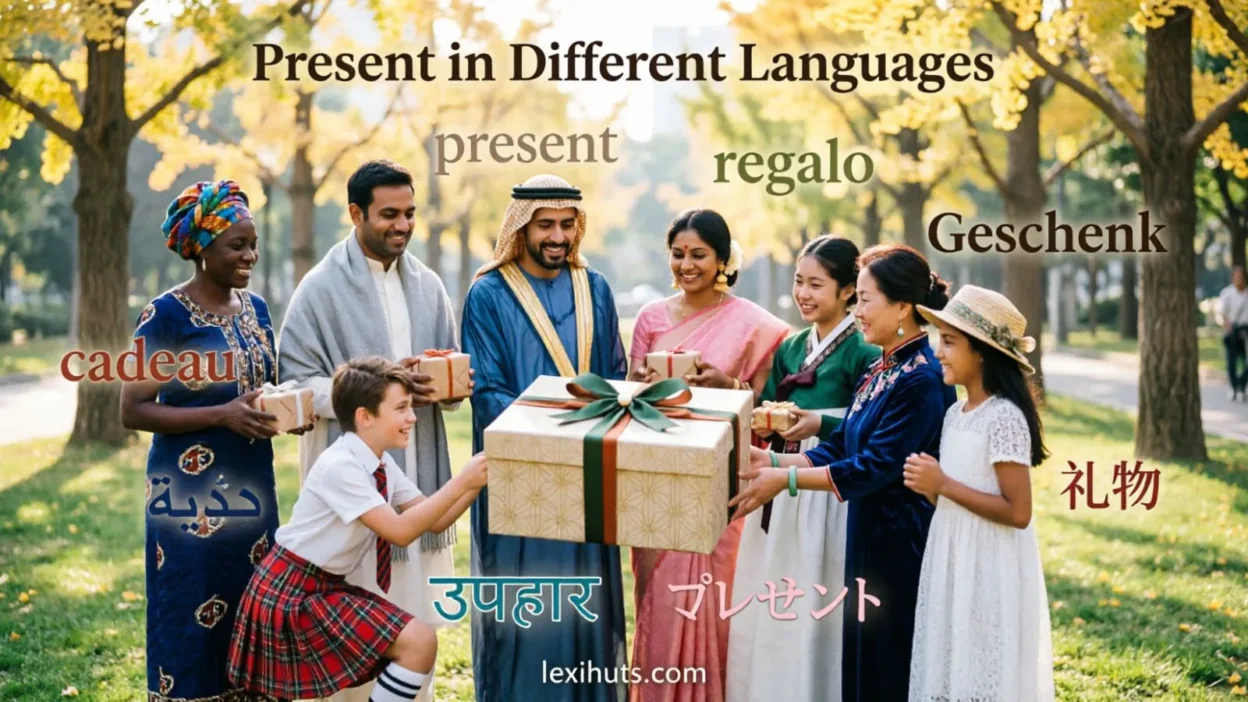
Learning how to say present in different languages is a great way to improve your communication skills, understand different cultures, and expand your vocabulary.
If you are traveling, studying a new language, teaching students, or simply curious about global expressions, knowing the translation of the word “present” can be very useful.
The word present can have multiple meanings, including a gift, being available, or existing in a particular place.
In this article, we focus primarily on the meaning of present as a gift and explore how it is expressed in many languages across the world.
What Does “Present” Mean?
Definition of Present
Definition: A present is something given to someone without expecting payment in return, usually on a special occasion such as a birthday, holiday, or celebration.
Meaning: The word is commonly used interchangeably with “gift” and often symbolizes appreciation, love, gratitude, or celebration.
Present in Different Languages
1. Spanish
Phrase: Regalo
Pronunciation: reh-GAH-loh
Meaning: Gift or present given to someone on a special occasion.
2. French
Phrase: Cadeau
Pronunciation: kah-DOH
Meaning: A gift or present offered to another person.
3. German
Phrase: Geschenk
Pronunciation: guh-SHENK
Meaning: A present or gift.
4. Italian
Phrase: Regalo
Pronunciation: reh-GAH-loh
Meaning: A gift given to celebrate an event.
5. Portuguese
Phrase: Presente
Pronunciation: preh-ZEN-chee
Meaning: Gift or present.
6. Dutch
Phrase: Cadeau
Pronunciation: kah-DOH
Meaning: A gift for someone.
7. Russian
Phrase: Подарок (Podarok)
Pronunciation: pah-DAH-rok
Meaning: Present or gift.
8. Ukrainian
Phrase: Подарунок (Podarunok)
Pronunciation: poh-dah-ROO-nok
Meaning: Gift or present.
9. Polish
Phrase: Prezent
Pronunciation: PREH-zent
Meaning: Present or gift.
10. Czech
Phrase: Dárek
Pronunciation: DAA-rek
Meaning: Gift or present.
11. Slovak
Phrase: Darček
Pronunciation: DAR-chek
Meaning: A small gift or present.
12. Hungarian
Phrase: Ajándék
Pronunciation: ah-YAN-dayk
Meaning: Gift or present.
13. Romanian
Phrase: Cadou
Pronunciation: kah-DOU
Meaning: Present or gift.
14. Greek
Phrase: Δώρο (Doro)
Pronunciation: THO-ro
Meaning: Gift or present.
15. Turkish
Phrase: Hediye
Pronunciation: heh-dee-YEH
Meaning: Present or gift.
16. Arabic
Phrase: هدية (Hadiya)
Pronunciation: hah-DEE-yah
Meaning: Gift or present.
17. Hebrew
Phrase: מתנה (Matanah)
Pronunciation: mah-tah-NAH
Meaning: Present or gift.
18. Persian
Phrase: هدیه (Hadiyeh)
Pronunciation: hah-dee-YEH
Meaning: Gift or present.
19. Hindi
Phrase: उपहार (Upahaar)
Pronunciation: oo-pa-HAAR
Meaning: Gift or present.
20. Urdu
Phrase: تحفہ (Tohfa)
Pronunciation: TOH-fah
Meaning: Present or gift.
21. Bengali
Phrase: উপহার (Upohar)
Pronunciation: oo-po-HAR
Meaning: Gift or present.
22. Punjabi
Phrase: ਤੋਹਫ਼ਾ (Tohfa)
Pronunciation: TOH-fah
Meaning: Present or gift.
23. Tamil
Phrase: பரிசு (Parisu)
Pronunciation: pah-REE-soo
Meaning: Gift or present.
24. Telugu
Phrase: బహుమతి (Bahumati)
Pronunciation: bah-hoo-MAH-tee
Meaning: Present or gift.
25. Kannada
Phrase: ಉಡುಗೊರೆ (Udugore)
Pronunciation: oo-doo-GO-ray
Meaning: Gift or present.
26. Malayalam
Phrase: സമ്മാനം (Sammanam)
Pronunciation: sahm-MAA-nam
Meaning: Present or gift.
27. Marathi
Phrase: भेट (Bhet)
Pronunciation: BHET
Meaning: Gift or present.
28. Gujarati
Phrase: ભેટ (Bhet)
Pronunciation: BHET
Meaning: Present or gift.
29. Chinese (Mandarin)
Phrase: 礼物 (Lǐwù)
Pronunciation: lee-WOO
Meaning: Gift or present.
30. Japanese
Phrase: プレゼント (Purezento)
Pronunciation: poo-reh-ZEN-toh
Meaning: Present or gift.
31. Korean
Phrase: 선물 (Seonmul)
Pronunciation: SUN-mool
Meaning: Gift or present.
32. Vietnamese
Phrase: Quà tặng
Pronunciation: kwah-tang
Meaning: Present or gift.
33. Thai
Phrase: ของขวัญ (Khong Khwan)
Pronunciation: khong-KWAN
Meaning: Gift or present.
34. Indonesian
Phrase: Hadiah
Pronunciation: hah-DEE-ah
Meaning: Present or gift.
35. Malay
Phrase: Hadiah
Pronunciation: hah-DEE-ah
Meaning: Gift or present.
36. Filipino
Phrase: Regalo
Pronunciation: reh-GAH-lo
Meaning: Present or gift.
37. Swahili
Phrase: Zawadi
Pronunciation: zah-WAH-dee
Meaning: Gift or present.
38. Afrikaans
Phrase: Geskenk
Pronunciation: khes-KENK
Meaning: Present or gift.
39. Zulu
Phrase: Isipho
Pronunciation: ee-SEE-poh
Meaning: Gift or present.
40. Xhosa
Phrase: Isipho
Pronunciation: ee-SEE-poh
Meaning: Present or gift.
41. Danish
Phrase: Gave
Pronunciation: GAH-veh
Meaning: Gift or present.
42. Swedish
Phrase: Present
Pronunciation: preh-SENT
Meaning: Gift or present.
43. Norwegian
Phrase: Gave
Pronunciation: GAH-veh
Meaning: Present or gift.
44. Finnish
Phrase: Lahja
Pronunciation: LAH-yah
Meaning: Gift or present.
45. Icelandic
Phrase: Gjöf
Pronunciation: GYUV
Meaning: Present or gift.
46. Irish
Phrase: Bronntanas
Pronunciation: BRUN-tan-us
Meaning: Gift or present.
47. Welsh
Phrase: Anrheg
Pronunciation: AN-hreg
Meaning: Present or gift.
48. Albanian
Phrase: Dhuratë
Pronunciation: dhu-RAH-tuh
Meaning: Gift or present.
49. Serbian
Phrase: Poklon
Pronunciation: POH-klon
Meaning: Present or gift.
50. Croatian
Phrase: Poklon
Pronunciation: POH-klon
Meaning: Gift or present.
Why Learning “Present” in Different Languages Is Important
Understanding how to say present in various languages helps improve international communication and cultural awareness. It is especially useful for travelers, students, teachers, translators, and business professionals who interact with people from different backgrounds.
Learning gift-related vocabulary can also make holiday celebrations, birthday greetings, and social interactions more meaningful. Even knowing a single word in another language can help build stronger connections with people around the world.
Useful Tips for Learning Words in Multiple Languages
Focus on Pronunciation
Learning correct pronunciation helps you communicate confidently and avoid misunderstandings.
Practice With Native Speakers
Speaking with native speakers improves your accent and helps you remember vocabulary longer.
Use Words in Sentences
Instead of memorizing single words, create simple sentences that include the translation.
Group Similar Languages Together
Studying related languages can make vocabulary learning faster because many words share common roots.
Review Regularly
Consistent review helps transfer new vocabulary from short-term memory to long-term memory.
Conclusion
Learning how to say present in different languages is an enjoyable way to explore global cultures and expand your language skills.
From Spanish Regalo to Chinese Lǐwù and Arabic Hadiya, each translation reflects the universal tradition of giving gifts and showing appreciation.
By practicing these words regularly, you can communicate more effectively and gain a deeper understanding of people around the world.
FAQs:
1. How do you say present in Spanish?
The word for present in Spanish is Regalo, which means a gift given to someone on a special occasion.
2. What is the Japanese word for present?
In Japanese, present is プレゼント (Purezento), a commonly used term for a gift.
3. Is present the same as gift in most languages?
Yes, in many languages the words for present and gift are used interchangeably and carry the same meaning.
4. Why should I learn present in different languages?
Learning translations helps improve communication, cultural understanding, travel experiences, and language skills.
5. Which languages use a word similar to present?
Languages such as Portuguese (Presente), Polish (Prezent), and Swedish (Present) use words that closely resemble the English term.