
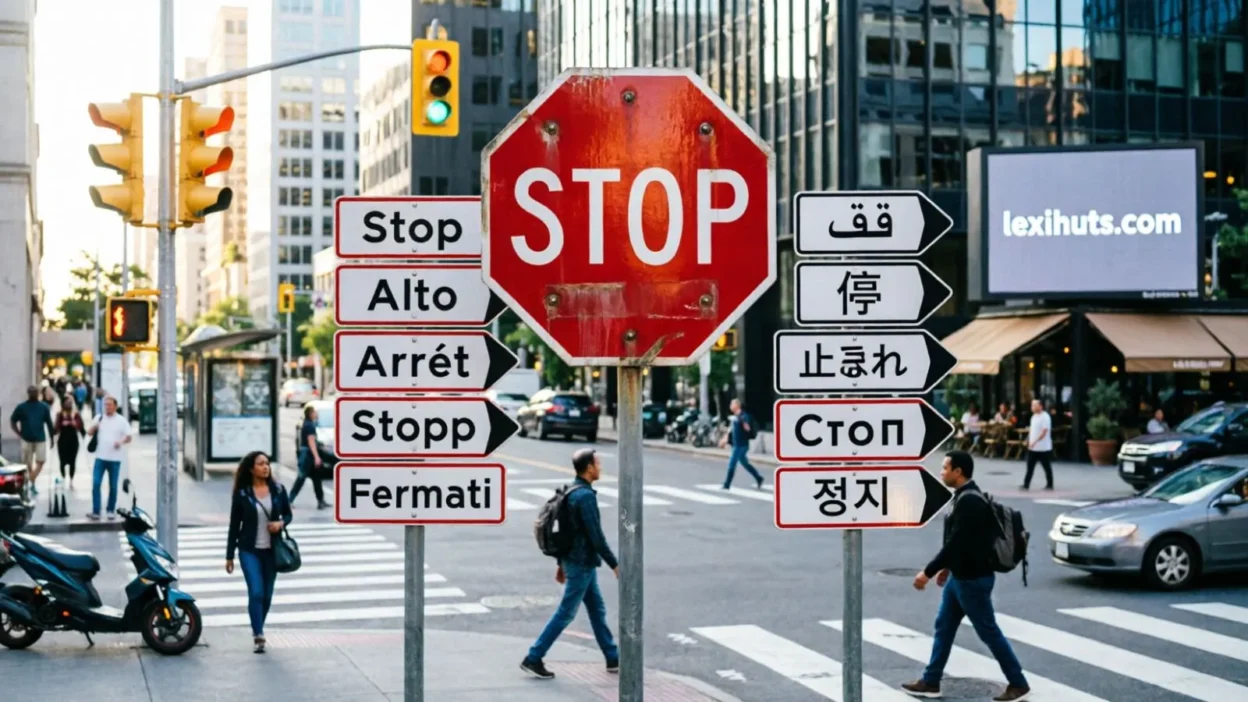
The word “stop” is one of the most important and widely used words in any language.
If you are traveling, learning a new language, communicating with international friends, or simply expanding your vocabulary, knowing how to say stop in different languages can be incredibly useful.
From asking someone to stop talking to understanding road signs and safety instructions, this simple word plays a vital role in daily communication.
In this guide, you’ll discover how to say “stop” in many languages, along with pronunciations, meanings, and examples.
This resource is designed for language learners, travelers, students, and anyone interested in global languages and cultures.
What Does “Stop” Mean?
Definition:
The word stop means to cease movement, discontinue an action, bring something to an end, or prevent further progress.
Meaning:
It can be used as a command, instruction, warning, or request depending on the situation.
Example:
“Please stop talking during the meeting.”
Stop in Different Languages
1. Stop in Spanish
Phrase: Alto / Detente
Pronunciation: Ahl-toh / Deh-ten-teh
Meaning: Stop or halt
Example: “¡Alto!” means “Stop!”
2. Stop in French
Phrase: Arrêtez
Pronunciation: Ah-reh-tay
Meaning: Stop
Example: “Arrêtez immédiatement.”
3. Stop in German
Phrase: Stopp
Pronunciation: Shtop
Meaning: Stop
Example: “Stopp bitte.”
4. Stop in Italian
Phrase: Fermati
Pronunciation: Fehr-mah-tee
Meaning: Stop
Example: “Fermati qui.”
5. Stop in Portuguese
Phrase: Pare
Pronunciation: Pah-reh
Meaning: Stop
Example: “Pare agora.”
6. Stop in Dutch
Phrase: Stop
Pronunciation: Stop
Meaning: Stop
Example: “Stop onmiddellijk.”
7. Stop in Russian
Phrase: Стоп (Stop)
Pronunciation: Stop
Meaning: Stop
Example: “Стоп сейчас.”
8. Stop in Chinese (Mandarin)
Phrase: 停 (Tíng)
Pronunciation: Ting
Meaning: Stop
Example: “请停下。”
9. Stop in Japanese
Phrase: 止まれ (Tomare)
Pronunciation: Toh-mah-reh
Meaning: Stop
Example: “止まれ!”
10. Stop in Korean
Phrase: 멈춰 (Meomchwo)
Pronunciation: Mum-chwo
Meaning: Stop
Example: “지금 멈춰.”
11. Stop in Arabic
Phrase: توقف (Tawaqqaf)
Pronunciation: Ta-waq-qaf
Meaning: Stop
Example: “توقف الآن.”
12. Stop in Hindi
Phrase: रुको (Ruko)
Pronunciation: Roo-koh
Meaning: Stop
Example: “रुको!”
13. Stop in Urdu
Phrase: رکو (Ruko)
Pronunciation: Roo-koh
Meaning: Stop
Example: “رکو یہاں۔”
14. Stop in Bengali
Phrase: থামো (Thamo)
Pronunciation: Tha-mo
Meaning: Stop
Example: “থামো।”
15. Stop in Punjabi
Phrase: ਰੁਕੋ (Ruko)
Pronunciation: Roo-koh
Meaning: Stop
Example: “ਰੁਕੋ ਜੀ।”
16. Stop in Turkish
Phrase: Dur
Pronunciation: Door
Meaning: Stop
Example: “Dur!”
17. Stop in Greek
Phrase: Σταμάτα (Stamata)
Pronunciation: Sta-ma-ta
Meaning: Stop
Example: “Σταμάτα τώρα.”
18. Stop in Polish
Phrase: Stop
Pronunciation: Stop
Meaning: Stop
Example: “Stop tutaj.”
19. Stop in Swedish
Phrase: Stopp
Pronunciation: Stop
Meaning: Stop
Example: “Stopp nu.”
20. Stop in Norwegian
Phrase: Stopp
Pronunciation: Stop
Meaning: Stop
Example: “Stopp der.”
21. Stop in Danish
Phrase: Stop
Pronunciation: Stop
Meaning: Stop
Example: “Stop nu.”
22. Stop in Finnish
Phrase: Pysähdy
Pronunciation: Poo-saah-dy
Meaning: Stop
Example: “Pysähdy tähän.”
23. Stop in Czech
Phrase: Zastav
Pronunciation: Zah-stav
Meaning: Stop
Example: “Zastav!”
24. Stop in Slovak
Phrase: Zastav
Pronunciation: Zah-stav
Meaning: Stop
Example: “Zastav sa.”
25. Stop in Romanian
Phrase: Oprește-te
Pronunciation: Oh-presh-teh-teh
Meaning: Stop
Example: “Oprește-te acum.”
26. Stop in Hungarian
Phrase: Állj
Pronunciation: Ahl-y
Meaning: Stop
Example: “Állj meg.”
27. Stop in Thai
Phrase: หยุด (Yut)
Pronunciation: Yoot
Meaning: Stop
Example: “หยุด!”
28. Stop in Vietnamese
Phrase: Dừng lại
Pronunciation: Zoong Lai
Meaning: Stop
Example: “Dừng lại ngay.”
29. Stop in Indonesian
Phrase: Berhenti
Pronunciation: Ber-hen-tee
Meaning: Stop
Example: “Berhenti sekarang.”
30. Stop in Malay
Phrase: Berhenti
Pronunciation: Ber-hen-tee
Meaning: Stop
Example: “Berhenti di sini.”
31. Stop in Hebrew
Phrase: עצור (Atzor)
Pronunciation: Aht-zor
Meaning: Stop
Example: “עצור עכשיו.”
32. Stop in Swahili
Phrase: Simama
Pronunciation: See-ma-ma
Meaning: Stop
Example: “Simama hapo.”
33. Stop in Zulu
Phrase: Yima
Pronunciation: Yee-ma
Meaning: Stop
Example: “Yima!”
34. Stop in Afrikaans
Phrase: Stop
Pronunciation: Stop
Meaning: Stop
Example: “Stop nou.”
35. Stop in Filipino
Phrase: Tigil
Pronunciation: Tee-gil
Meaning: Stop
Example: “Tigil na.”
Why Learning “Stop” in Different Languages Is Important
Knowing how to say stop in different languages offers several advantages:
- Improves communication while traveling internationally.
- Helps in emergencies and safety situations.
- Enhances language-learning skills.
- Builds cultural awareness and understanding.
- Makes conversations with native speakers easier.
- Helps recognize international road signs and instructions.
Practical Tips for Learning Stop in Multiple Languages
Learn by Language Families
Languages from the same family often share similar words. For example, Spanish, Portuguese, and Italian have related vocabulary.
Practice Pronunciation
Listen to native speakers and repeat the word several times to improve accuracy.
Use Flashcards
Create flashcards with the language name on one side and the translation of stop on the other.
Learn Contextual Usage
Some languages use different forms depending on formality, gender, or the situation.
Focus on Common Travel Languages
Start with widely spoken languages such as Spanish, French, Arabic, Mandarin Chinese, Hindi, and German.
Common Variations of the Word Stop
Stop as a Command
Used to tell someone to immediately cease an action.
Stop as a Traffic Sign
Used on roads and highways to indicate that vehicles must halt.
Stop as a Request
Used politely when asking someone to discontinue an action.
Stop as a Safety Warning
Used in emergencies to prevent danger or harm.
Conclusion
Learning stop in different languages is both practical and educational.
If you are traveling abroad, studying languages, or communicating with people from different cultures, knowing this essential word can help you navigate conversations and situations more effectively.
By mastering these translations, you gain valuable language skills and a deeper appreciation for global communication.
FAQs:
1. How do you say stop in the most spoken languages?
Stop is commonly translated as Alto in Spanish, Arrêtez in French, Stopp in German, Tíng in Mandarin Chinese, and Ruko in Hindi and Urdu.
2. What is stop in Japanese?
The Japanese word for stop is 止まれ (Tomare), which is often seen on road signs and used as a command.
3. How do you say stop in Arabic?
In Arabic, stop is commonly translated as توقف (Tawaqqaf).
4. Why is it useful to learn stop in different languages?
It helps with travel, safety, emergency communication, language learning, and understanding international signs and instructions.
5. Is the word stop the same in every language?
No, each language has its own translation and pronunciation, although some languages use a similar form such as “Stop” or “Stopp.