Language is one of the most fascinating ways to understand different cultures.
If you have ever wondered how to say man in different languages, you are not alone.
Many people search for translations of common words to improve language learning, communicate while traveling, or simply expand their knowledge of global cultures.
The word man generally refers to an adult male human, but its translation can vary significantly from one language to another.
In this guide, you’ll discover how to say man in different languages, along with pronunciation tips, meanings, and useful examples.
What Does the Word “Man” Mean?
A man is typically defined as an adult male human being. The term is widely used in everyday conversations, literature, history, and culture. Learning its translation in multiple languages can help you communicate more effectively across different regions of the world.
Man in Different Languages
1. English
Phrase: Man
Pronunciation: Man
Meaning: An adult male human being.
2. Spanish
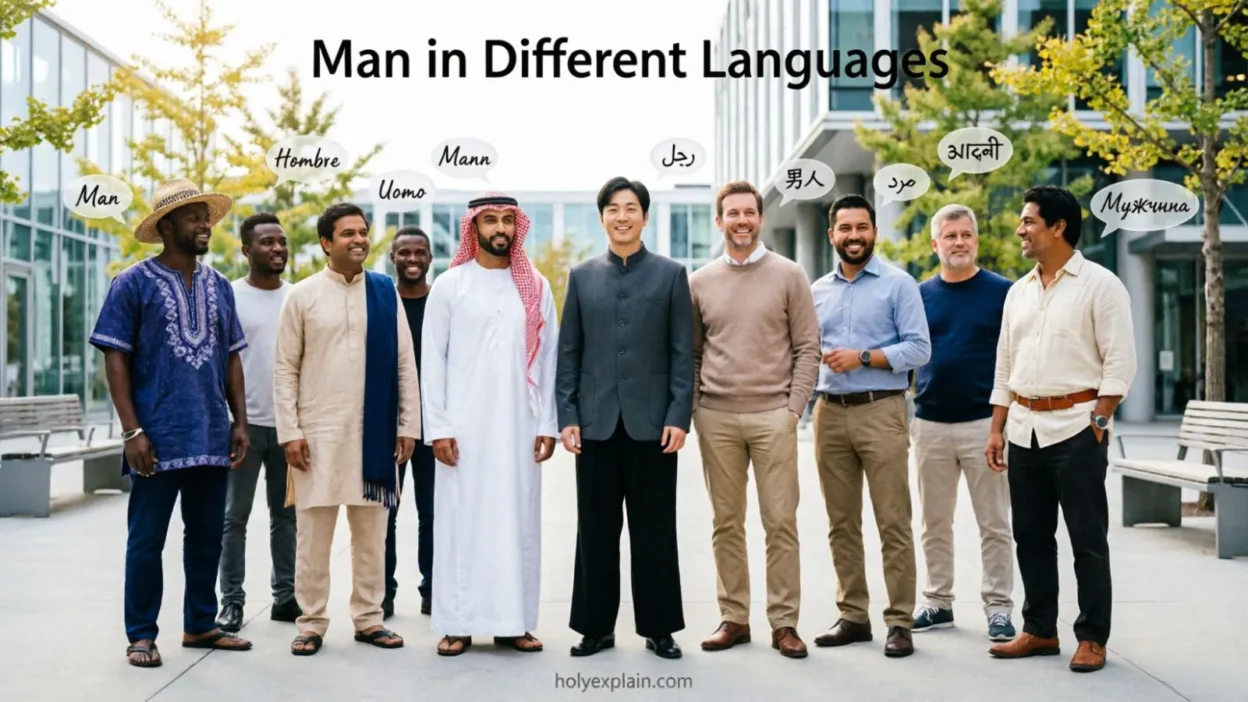
Phrase: Hombre
Pronunciation: OM-breh
Meaning: Common Spanish word for man.
3. French
Phrase: Homme
Pronunciation: Om
Meaning: Refers to an adult male.
4. German
Phrase: Mann
Pronunciation: Man
Meaning: Adult male person.
5. Italian
Phrase: Uomo
Pronunciation: WOH-mo
Meaning: Man or male individual.
6. Portuguese
Phrase: Homem
Pronunciation: O-meng
Meaning: Adult male human.
7. Dutch
Phrase: Man
Pronunciation: Man
Meaning: Adult male.
8. Russian
Phrase: Мужчина
Pronunciation: Moozh-CHEE-na
Meaning: Man or gentleman.
9. Ukrainian
Phrase: Чоловік
Pronunciation: Cho-lo-VIK
Meaning: Man or husband.
10. Polish
Phrase: Mężczyzna
Pronunciation: Men-CHIZ-na
Meaning: Adult male person.
11. Czech
Phrase: Muž
Pronunciation: Moozh
Meaning: Man.
12. Slovak
Phrase: Muž
Pronunciation: Moozh
Meaning: Adult male.
13. Hungarian
Phrase: Férfi
Pronunciation: Fair-fee
Meaning: Man.
14. Romanian
Phrase: Bărbat
Pronunciation: Ber-bat
Meaning: Adult male.
15. Greek
Phrase: Άνδρας
Pronunciation: AN-dras
Meaning: Man.
16. Turkish
Phrase: Erkek
Pronunciation: Er-kek
Meaning: Male or man.
17. Arabic
Phrase: رجل
Pronunciation: Ra-jul
Meaning: Man.
18. Hebrew
Phrase: גבר
Pronunciation: Ge-ver
Meaning: Man or male.
19. Persian
Phrase: مرد
Pronunciation: Mard
Meaning: Man.
20. Urdu
Phrase: مرد
Pronunciation: Mard
Meaning: Adult male human.
21. Hindi
Phrase: आदमी
Pronunciation: Aad-mi
Meaning: Man or person.
22. Punjabi
Phrase: ਮਰਦ
Pronunciation: Mard
Meaning: Man.
23. Bengali
Phrase: মানুষ
Pronunciation: Ma-noosh
Meaning: Person or man depending on context.
24. Gujarati
Phrase: માણસ
Pronunciation: Maa-nas
Meaning: Man or person.
25. Marathi
Phrase: माणूस
Pronunciation: Maa-noos
Meaning: Man or human.
26. Tamil
Phrase: மனிதன்
Pronunciation: Ma-ni-than
Meaning: Man.
27. Telugu
Phrase: మనిషి
Pronunciation: Ma-ni-shee
Meaning: Human or man.
28. Kannada
Phrase: ಮನುಷ್ಯ
Pronunciation: Ma-nush-ya
Meaning: Man or human.
29. Malayalam
Phrase: മനുഷ്യൻ
Pronunciation: Ma-nu-shyan
Meaning: Man.
30. Chinese (Mandarin)
Phrase: 男人
Pronunciation: Nán Rén
Meaning: Adult male.
31. Japanese
Phrase: 男
Pronunciation: Otoko
Meaning: Man.
32. Korean
Phrase: 남자
Pronunciation: Nam-ja
Meaning: Male or man.
33. Thai
Phrase: ผู้ชาย
Pronunciation: Poo-chai
Meaning: Man.
34. Vietnamese
Phrase: Đàn ông
Pronunciation: Dan Ong
Meaning: Adult male.
35. Indonesian
Phrase: Pria
Pronunciation: Pree-ah
Meaning: Man.
36. Malay
Phrase: Lelaki
Pronunciation: Le-la-kee
Meaning: Man.
37. Filipino
Phrase: Lalaki
Pronunciation: La-la-kee
Meaning: Male person.
38. Swahili
Phrase: Mwanaume
Pronunciation: Mwa-na-oo-me
Meaning: Man.
39. Afrikaans
Phrase: Man
Pronunciation: Man
Meaning: Adult male.
40. Zulu
Phrase: Indoda
Pronunciation: In-do-da
Meaning: Man.
41. Norwegian
Phrase: Mann
Pronunciation: Man
Meaning: Man.
42. Swedish
Phrase: Man
Pronunciation: Man
Meaning: Adult male.
43. Danish
Phrase: Mand
Pronunciation: Mand
Meaning: Man.
44. Finnish
Phrase: Mies
Pronunciation: Mee-es
Meaning: Man.
45. Icelandic
Phrase: Maður
Pronunciation: Ma-thur
Meaning: Man.
46. Irish
Phrase: Fear
Pronunciation: Far
Meaning: Man.
47. Welsh
Phrase: Dyn
Pronunciation: Din
Meaning: Man.
48. Albanian
Phrase: Burrë
Pronunciation: Boo-reh
Meaning: Man.
49. Serbian
Phrase: Muškarac
Pronunciation: Moosh-ka-rats
Meaning: Adult male.
50. Croatian
Phrase: Muškarac
Pronunciation: Moosh-ka-rats
Meaning: Man.
Why Learning “Man” in Different Languages Is Important
Understanding how to say man in different languages improves communication and cultural awareness. Whether you’re traveling, studying foreign languages, translating content, or interacting with international communities, knowing common vocabulary words helps build stronger connections.
It also provides insight into linguistic similarities and differences across cultures. Many European languages share related terms, while Asian and African languages often use completely distinct words.
Practical Tips for Learning Words in Different Languages
Focus on Pronunciation
Learning the correct pronunciation is just as important as memorizing the word itself.
Practice With Native Speakers
Using new vocabulary in conversation helps improve retention and confidence.
Learn Related Vocabulary
Along with “man,” learn words such as woman, boy, girl, father, and family.
Use Language Apps
Daily practice through language-learning tools can help you remember translations more effectively.
Create Flashcards
Flashcards are an excellent way to review vocabulary and improve long-term memory.
Conclusion
Learning how to say man in different languages is a simple yet valuable step toward understanding global cultures and improving multilingual communication.
From Spanish hombre and French homme to Chinese 男人 and Arabic رجل, every language offers a unique way to express this common word.
Expanding your vocabulary across languages can make travel, learning, and cultural exchanges more meaningful.
FAQs:
1. How do you say man in Spanish?
The word for man in Spanish is Hombre.
2. What is the French word for man?
In French, man is translated as Homme.
3. How do you say man in Japanese?
The Japanese word for man is 男 (Otoko).
4. What is the Chinese word for man?
In Mandarin Chinese, man is 男人 (Nán Rén).
5. Why learn common words in different languages?
Learning common words improves communication, cultural understanding, and language-learning skills.