
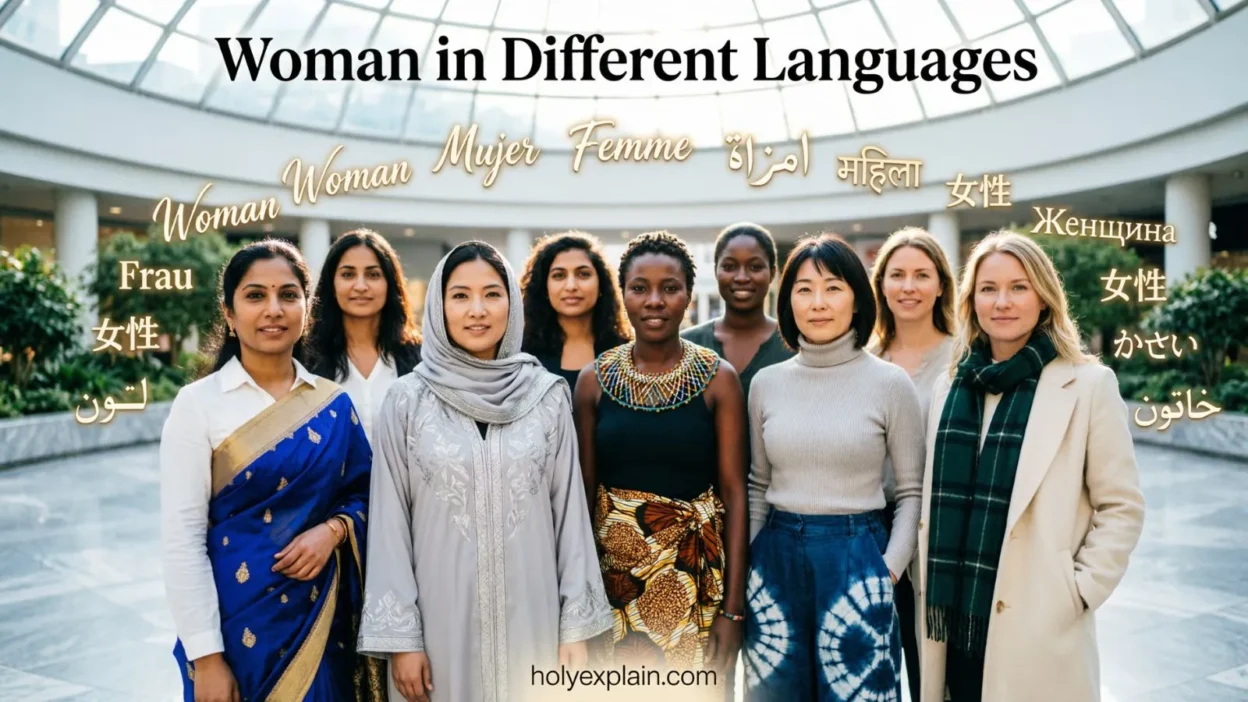
Women play a vital role in every culture, society, and language.
If you are searching for how to say “woman” in different languages, this guide provides translations, pronunciations, meanings, and examples from around the world.
If you are learning a new language, traveling internationally, studying linguistics, or simply curious about global cultures, understanding how different languages express the word “woman” can be both educational and fascinating.
The term “woman” generally refers to an adult female human, but its pronunciation, spelling, and cultural usage vary significantly across languages.
Below, you will find common translations and useful insights to help you understand this important word in many languages.
Woman Meaning and Definition
Definition: A woman is an adult female human being.
Meaning: The word is used to identify an adult female and may also represent concepts of femininity, motherhood, leadership, strength, and cultural identity depending on the context.
How to Say Woman in Different Languages
1. Woman in Spanish
Phrase: Mujer
Pronunciation: Moo-hehr
Example: Ella es una mujer inteligente.
Meaning: Refers to an adult female person.
2. Woman in French
Phrase: Femme
Pronunciation: Fahm
Example: C’est une femme gentille.
Meaning: Adult woman or wife depending on context.
3. Woman in German
Phrase: Frau
Pronunciation: Frow
Example: Sie ist eine freundliche Frau.
Meaning: Woman or a respectful title for a lady.
4. Woman in Italian
Phrase: Donna
Pronunciation: Don-nah
Example: Lei è una donna forte.
Meaning: Adult female person.
5. Woman in Portuguese
Phrase: Mulher
Pronunciation: Moo-lyehr
Example: Ela é uma mulher talentosa.
Meaning: Woman or female adult.
6. Woman in Dutch
Phrase: Vrouw
Pronunciation: Vrow
Example: Zij is een vriendelijke vrouw.
Meaning: Woman or wife.
7. Woman in Russian
Phrase: Женщина (Zhenschina)
Pronunciation: Zhen-shee-na
Example: Она красивая женщина.
Meaning: Adult woman.
8. Woman in Ukrainian
Phrase: Жінка (Zhinka)
Pronunciation: Zheen-ka
Example: Вона добра жінка.
Meaning: Woman or wife.
9. Woman in Polish
Phrase: Kobieta
Pronunciation: Ko-bye-ta
Example: To jest kobieta.
Meaning: Adult female.
10. Woman in Czech
Phrase: Žena
Pronunciation: Zhe-na
Example: Ona je hodná žena.
Meaning: Woman or wife.
11. Woman in Slovak
Phrase: Žena
Pronunciation: Zhe-na
Meaning: Adult female person.
12. Woman in Croatian
Phrase: Žena
Pronunciation: Zhe-na
Meaning: Woman or wife.
13. Woman in Serbian
Phrase: Žena
Pronunciation: Zhe-na
Meaning: Female adult.
14. Woman in Slovenian
Phrase: Ženska
Pronunciation: Zhen-ska
Meaning: Woman.
15. Woman in Greek
Phrase: Γυναίκα (Gynaika)
Pronunciation: Yee-ne-ka
Meaning: Woman.
16. Woman in Turkish
Phrase: Kadın
Pronunciation: Ka-dun
Meaning: Adult female.
17. Woman in Arabic
Phrase: امرأة (Imra’ah)
Pronunciation: Im-ra-ah
Meaning: Woman.
18. Woman in Hebrew
Phrase: אישה (Isha)
Pronunciation: Ee-sha
Meaning: Woman or wife.
19. Woman in Persian
Phrase: زن (Zan)
Pronunciation: Zan
Meaning: Woman.
20. Woman in Urdu
Phrase: عورت (Aurat)
Pronunciation: Aw-rat
Meaning: Adult female.
21. Woman in Hindi
Phrase: महिला (Mahila)
Pronunciation: Ma-hee-la
Meaning: Woman or lady.
22. Woman in Bengali
Phrase: মহিলা (Mohila)
Pronunciation: Mo-hee-la
Meaning: Adult female.
23. Woman in Punjabi
Phrase: ਔਰਤ (Aurat)
Pronunciation: Aw-rat
Meaning: Woman.
24. Woman in Gujarati
Phrase: મહિલા (Mahila)
Pronunciation: Ma-hee-la
Meaning: Woman.
25. Woman in Marathi
Phrase: स्त्री (Stri)
Pronunciation: Stree
Meaning: Female or woman.
26. Woman in Tamil
Phrase: பெண் (Pen)
Pronunciation: Pen
Meaning: Woman or female.
27. Woman in Telugu
Phrase: మహిళ (Mahila)
Pronunciation: Ma-hee-la
Meaning: Woman.
28. Woman in Kannada
Phrase: ಮಹಿಳೆ (Mahile)
Pronunciation: Ma-hee-lay
Meaning: Woman.
29. Woman in Malayalam
Phrase: സ്ത്രീ (Sthree)
Pronunciation: Stree
Meaning: Adult female.
30. Woman in Chinese
Phrase: 女人 (Nǚrén)
Pronunciation: Nyoo-ren
Meaning: Woman.
31. Woman in Japanese
Phrase: 女性 (Josei)
Pronunciation: Jo-say
Meaning: Woman or female.
32. Woman in Korean
Phrase: 여성 (Yeoseong)
Pronunciation: Yuh-song
Meaning: Woman.
33. Woman in Vietnamese
Phrase: Phụ nữ
Pronunciation: Foo-noo
Meaning: Woman.
34. Woman in Thai
Phrase: ผู้หญิง (Phu Ying)
Pronunciation: Poo-ying
Meaning: Woman.
35. Woman in Indonesian
Phrase: Wanita
Pronunciation: Wa-nee-ta
Meaning: Adult female.
36. Woman in Malay
Phrase: Wanita
Pronunciation: Wa-nee-ta
Meaning: Woman.
37. Woman in Filipino
Phrase: Babae
Pronunciation: Ba-ba-eh
Meaning: Woman or female.
38. Woman in Swahili
Phrase: Mwanamke
Pronunciation: Mwa-nam-kay
Meaning: Woman.
39. Woman in Afrikaans
Phrase: Vrou
Pronunciation: Frow
Meaning: Woman or wife.
40. Woman in Zulu
Phrase: Owesifazane
Pronunciation: Oh-we-see-fa-za-ne
Meaning: Woman.
41. Woman in Somali
Phrase: Haweeney
Pronunciation: Ha-way-nee
Meaning: Woman.
42. Woman in Amharic
Phrase: ሴት (Set)
Pronunciation: Set
Meaning: Woman or female.
43. Woman in Finnish
Phrase: Nainen
Pronunciation: Nai-nen
Meaning: Woman.
44. Woman in Swedish
Phrase: Kvinna
Pronunciation: Kvin-na
Meaning: Adult female.
45. Woman in Norwegian
Phrase: Kvinne
Pronunciation: Kvin-neh
Meaning: Woman.
46. Woman in Danish
Phrase: Kvinde
Pronunciation: Kvin-deh
Meaning: Woman.
47. Woman in Icelandic
Phrase: Kona
Pronunciation: Ko-na
Meaning: Woman or wife.
48. Woman in Hungarian
Phrase: Nő
Pronunciation: Nuh
Meaning: Woman.
49. Woman in Romanian
Phrase: Femeie
Pronunciation: Feh-may-ye
Meaning: Woman.
50. Woman in Lithuanian
Phrase: Moteris
Pronunciation: Mo-te-ris
Meaning: Adult female.
Why Learning Woman in Different Languages Is Important
Understanding how to say “woman” in different languages helps improve communication across cultures and countries. It is especially useful for travelers, language learners, students, translators, and professionals working in international environments.
Learning common vocabulary such as “woman” also helps build a strong foundation in new languages. Since the term appears frequently in daily conversations, books, media, and educational materials, it is one of the first words many learners encounter.
Useful Tips for Learning Language Translations
Practice Pronunciation Daily
Listen to native speakers and repeat the word several times to improve accuracy and confidence.
Learn Words in Context
Instead of memorizing translations alone, use them in complete sentences to remember them more effectively.
Compare Similar Languages
Many languages share related words. Recognizing patterns can make vocabulary learning faster and easier.
Use Flashcards
Create flashcards with the language, pronunciation, and meaning to strengthen memory retention.
Focus on Common Vocabulary
Learning essential words like woman, man, child, family, and greetings helps build practical language skills quickly.
Conclusion
The word “woman” is expressed differently across languages, reflecting the diversity and richness of global cultures.
If you are studying languages, traveling, or expanding your cultural knowledge, learning how to say woman in different languages is a valuable step toward better international communication and understanding.
FAQs
1. How do you say woman in Spanish?
The word for woman in Spanish is “Mujer.”
2. What is the French word for woman?
In French, woman is translated as “Femme.”
3. How do you say woman in Japanese?
The Japanese word for woman is “Josei” (女性).
4. What is the Arabic translation of woman?
In Arabic, woman is written as “امرأة” (Imra’ah).
5. Why should I learn common words in different languages?
Learning common words improves communication, enhances travel experiences, and helps build language skills more effectively.