
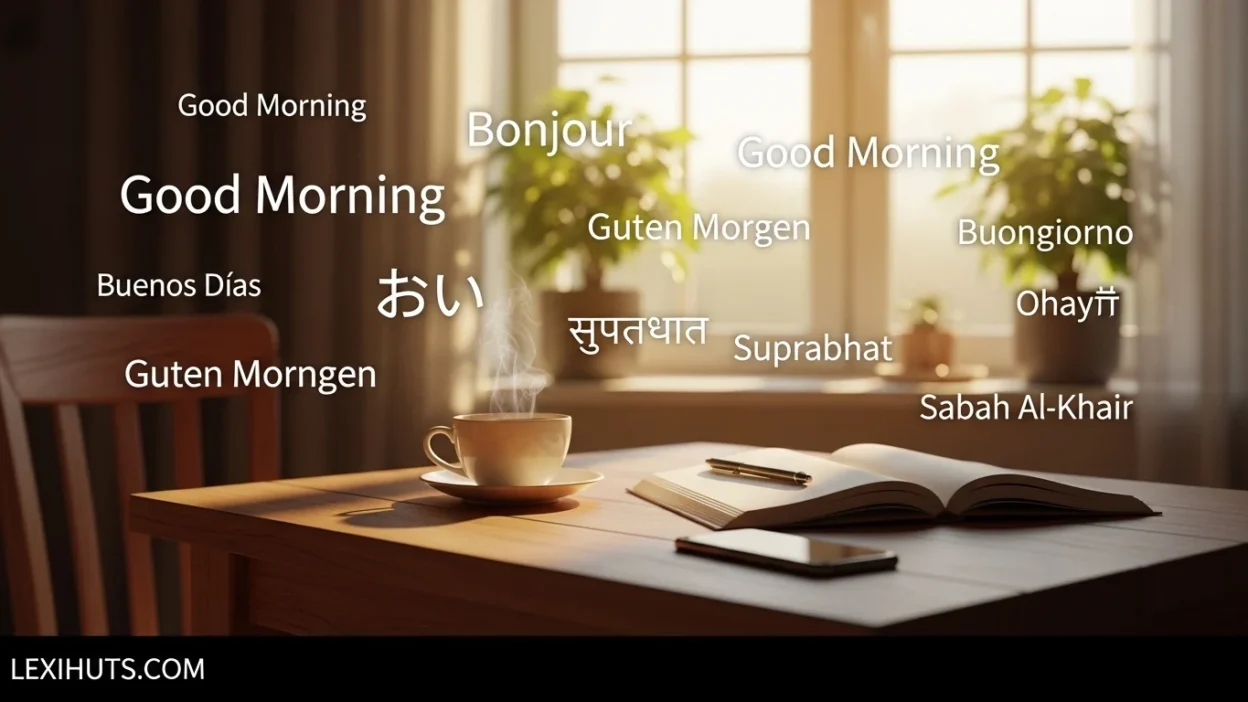
Saying “good morning” is one of the simplest ways to greet someone and start the day positively. Around the world, every culture has its own unique way of expressing this friendly greeting.
Learning good morning in different languages is not only useful for travelers but also a great way to understand global cultures, improve communication, and connect with people from different backgrounds.
In this guide, you’ll discover how to say good morning in many popular languages, along with pronunciation tips, meanings, and examples.
If you’re learning languages, traveling internationally, or just curious, this list will help you greet people around the world with confidence.
What Does “Good Morning” Mean in Different Languages?
“Good morning” is a polite greeting used to wish someone a pleasant start to the day. While the wording changes across languages, the purpose remains the same: expressing friendliness, respect, and positivity early in the day.
Different cultures use different phrases depending on the time of day, formality, and social context. Some languages also include honorific forms when greeting elders or strangers.
Popular Ways to Say Good Morning in Different Languages
1. Spanish
Phrase: Buenos días
Pronunciation: BWEH-nos DEE-as
Meaning: Good morning
Example: Buenos días, ¿cómo estás?
Explanation: Used widely in Spain and Latin American countries as a polite morning greeting.
2. French
Phrase: Bonjour
Pronunciation: Bon-ZHOOR
Meaning: Good day / Good morning
Example: Bonjour, comment allez-vous?
Explanation: Common greeting used until late afternoon in France and French-speaking regions.
3. German
Phrase: Guten Morgen
Pronunciation: GOO-ten MOR-gen
Meaning: Good morning
Example: Guten Morgen! Wie geht es Ihnen?
Explanation: Standard morning greeting used in Germany, Austria, and parts of Switzerland.
4. Italian
Phrase: Buongiorno
Pronunciation: Bwon-JOR-no
Meaning: Good morning
Example: Buongiorno, signore.
Explanation: Used until early afternoon in Italy.
5. Portuguese
Phrase: Bom dia
Pronunciation: Bom JEE-ah
Meaning: Good morning
Example: Bom dia! Tudo bem?
Explanation: Common greeting in Portugal and Brazil.
6. Japanese
Phrase: Ohayō gozaimasu
Pronunciation: Oh-ha-yo go-za-ee-mas
Meaning: Good morning
Example: Ohayō gozaimasu!
Explanation: Formal morning greeting in Japan.
7. Korean
Phrase: Annyeong haseyo
Pronunciation: An-nyong ha-se-yo
Meaning: Hello / Good morning
Example: Annyeong haseyo!
Explanation: Can be used at any time of day as a polite greeting.
8. Chinese (Mandarin)
Phrase: Zǎoshang hǎo
Pronunciation: Zao-shang how
Meaning: Good morning
Example: Zǎoshang hǎo!
Explanation: Used in China for morning greetings.
9. Arabic
Phrase: Sabah al-khair
Pronunciation: Sa-bah al-khair
Meaning: Morning of goodness
Example: Sabah al-khair!
Explanation: A warm greeting used across Arabic-speaking countries.
10. Hindi
Phrase: Suprabhat
Pronunciation: Soo-pra-bhaat
Meaning: Good morning
Example: Suprabhat!
Explanation: Formal greeting used in Hindi-speaking regions.
11. Russian
Phrase: Dobroye utro
Pronunciation: DO-bra-ye OO-tro
Meaning: Good morning
Example: Dobroye utro!
Explanation: Used across Russia and Russian-speaking communities.
12. Turkish
Phrase: Günaydın
Pronunciation: Goo-nai-dun
Meaning: Good morning
Example: Günaydın!
Explanation: A friendly greeting used in Turkey.
13. Greek
Phrase: Kalimera
Pronunciation: Ka-lee-MEH-ra
Meaning: Good morning
Example: Kalimera!
Explanation: Used from morning until early afternoon.
14. Swahili
Phrase: Habari za asubuhi
Pronunciation: Ha-ba-ree za a-su-bu-hee
Meaning: Good morning
Example: Habari za asubuhi?
Explanation: A common greeting in East Africa.
15. Dutch
Phrase: Goedemorgen
Pronunciation: Hoo-de MOR-ghen
Meaning: Good morning
Example: Goedemorgen!
Explanation: Standard morning greeting in the Netherlands and Belgium.
Why Learning “Good Morning” in Different Languages Is Important
Understanding how to say good morning in various languages can help you build stronger relationships with people worldwide. Simple greetings show respect and cultural awareness.
Key benefits include:
- Improving cross-cultural communication
- Making travel interactions easier
- Showing politeness and friendliness
- Building better connections in international environments
- Enhancing language learning skills
Even learning a few greetings can leave a positive impression when meeting people from different countries.
Practical Tips for Remembering Good Morning in Different Languages
Learning multiple greetings can feel overwhelming, but a few simple strategies make it easier.
Practice daily: Repeat phrases each morning to build memory.
Group languages by region: For example, learn European greetings together.
Use flashcards: Write the phrase on one side and pronunciation on the other.
Watch native speakers: Listening improves pronunciation accuracy.
Use greetings in conversation: Practicing with friends or language partners helps reinforce learning.
Consistency is the key to remembering these phrases naturally.
Conclusion
Learning good morning in different languages is a simple yet powerful way to connect with people across cultures.
If you’re traveling, studying languages, or expanding global awareness, these greetings help you start conversations with positivity and respect.
Even learning a few phrases can make interactions more meaningful and memorable.
FAQs:
1. How do you say good morning in the most common languages?
Common examples include Buenos días (Spanish), Bonjour (French), Guten Morgen (German), Buongiorno (Italian), and Ohayō gozaimasu (Japanese).
2. Why is it useful to learn greetings in different languages?
Learning greetings improves communication, shows respect for other cultures, and helps travelers interact more easily with locals.
3. What language greeting is used in many Arabic-speaking countries?
The common Arabic morning greeting is “Sabah al-khair,” which means “morning of goodness.”
4. Is “bonjour” only used for good morning?
No. In French, “bonjour” can mean both “good morning” and “good day” and is used until the afternoon.
5. What is the easiest way to remember greetings in multiple languages?
Practicing daily, using flashcards, and listening to native pronunciation can help you remember greetings quickly.