
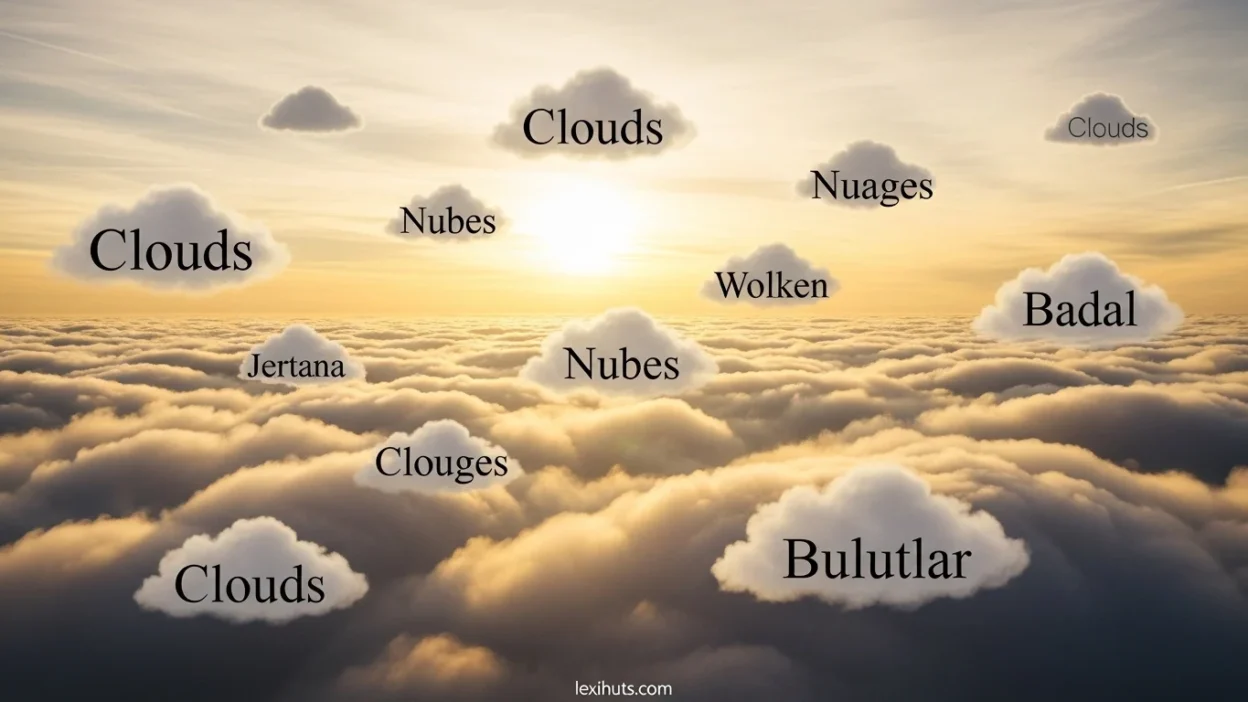
Clouds are a universal part of our sky, yet every culture describes them in a unique and beautiful way.
Learning how to say “clouds” in different languages not only expands your vocabulary but also gives you insight into how different cultures connect with nature and the atmosphere.
In this guide, you’ll discover how to say “clouds” across 30 languages, along with pronunciation, meanings, and examples.
If you’re a language learner, traveler, or content creator, this list will help you explore the world through words.
Clouds in 30 Different Languages
1. English
Phrase: Clouds
Pronunciation: klowdz
Meaning: Visible masses of condensed water vapor in the sky
Example: The clouds are forming before the rain.
2. Spanish
Phrase: Nubes
Pronunciation: noo-bes
Meaning: Floating water droplets in the sky
Example: Las nubes cubren el cielo.
3. French
Phrase: Nuages
Pronunciation: nwee-ahzh
Meaning: Sky formations made of vapor
Example: Les nuages sont gris aujourd’hui.
4. German
Phrase: Wolken
Pronunciation: vol-ken
Meaning: Clouds in the atmosphere
Example: Die Wolken sind sehr dunkel.
5. Italian
Phrase: Nuvole
Pronunciation: noo-vo-leh
Meaning: White or gray sky formations
Example: Le nuvole coprono il sole.
6. Portuguese
Phrase: Nuvens
Pronunciation: noo-vens
Meaning: Groups of water droplets in the sky
Example: As nuvens estão lindas hoje.
7. Dutch
Phrase: Wolken
Pronunciation: vol-ken
Meaning: Sky clouds
Example: De wolken bewegen snel.
8. Russian
Phrase: Облака (Oblaka)
Pronunciation: ob-lah-kah
Meaning: Clouds in the sky
Example: Облака белые и пушистые.
9. Arabic
Phrase: سحب (Suhub)
Pronunciation: soo-hub
Meaning: Clouds in the sky
Example: السحب جميلة اليوم.
10. Chinese (Mandarin)
Phrase: 云 (Yún)
Pronunciation: yoon
Meaning: Cloud or vapor formation
Example: 天上有很多云。
11. Japanese
Phrase: 雲 (Kumo)
Pronunciation: koo-moh
Meaning: Cloud in the sky
Example: 雲が空に広がっている。
12. Korean
Phrase: 구름 (Gureum)
Pronunciation: goo-room
Meaning: Clouds in the sky
Example: 구름이 많아요.
13. Hindi
Phrase: बादल (Baadal)
Pronunciation: baa-dal
Meaning: Cloud
Example: आसमान में बादल हैं।
14. Urdu
Phrase: بادل (Baadal)
Pronunciation: baa-dal
Meaning: Clouds
Example: آسمان پر بادل ہیں۔
15. Turkish
Phrase: Bulutlar
Pronunciation: boo-loot-lar
Meaning: Clouds in plural
Example: Bulutlar gökyüzünü kapladı.
16. Greek
Phrase: Σύννεφα (Synnefa)
Pronunciation: seen-neh-fa
Meaning: Clouds
Example: Τα σύννεφα είναι σκοτεινά.
17. Polish
Phrase: Chmury
Pronunciation: khmoo-ri
Meaning: Clouds
Example: Chmury są szare.
18. Swedish
Phrase: Moln
Pronunciation: moln
Meaning: Cloud or clouds
Example: Molnen rör sig snabbt.
19. Danish
Phrase: Skyer
Pronunciation: skoo-er
Meaning: Clouds
Example: Skyerne er hvide.
20. Norwegian
Phrase: Skyer
Pronunciation: shoo-er
Meaning: Clouds
Example: Skyene dekker solen.
21. Finnish
Phrase: Pilvet
Pronunciation: peel-vet
Meaning: Clouds
Example: Pilvet ovat kauniita.
22. Hungarian
Phrase: Felhők
Pronunciation: fel-herk
Meaning: Clouds
Example: A felhők sötétek.
23. Czech
Phrase: Mraky
Pronunciation: mrah-kee
Meaning: Clouds
Example: Mraky jsou šedé.
24. Slovak
Phrase: Oblaky
Pronunciation: ob-lah-kee
Meaning: Clouds
Example: Oblaky sú tmavé.
25. Thai
Phrase: เมฆ (Mek)
Pronunciation: mek
Meaning: Cloud
Example: มีเมฆบนท้องฟ้า
26. Vietnamese
Phrase: Mây
Pronunciation: may
Meaning: Cloud
Example: Trên trời có mây.
27. Indonesian
Phrase: Awan
Pronunciation: ah-wan
Meaning: Cloud
Example: Awan terlihat indah.
28. Swahili
Phrase: Mawingu
Pronunciation: mah-win-goo
Meaning: Clouds
Example: Mawingu yako juu angani.
29. Hebrew
Phrase: עננים (Ananim)
Pronunciation: ah-nah-neem
Meaning: Clouds
Example: העננים בשמיים.
30. Filipino (Tagalog)
Phrase: Ulap
Pronunciation: oo-lap
Meaning: Cloud
Example: Maraming ulap sa langit.
Why Learning “Clouds in Different Languages” Matters
Understanding how to say “clouds” in multiple languages helps improve your vocabulary and cultural awareness. It’s especially useful for travelers, students, and writers who want to connect more deeply with global audiences.
Language reflects how people view nature. By learning these words, you also explore how different cultures describe the sky and weather patterns in their daily lives.
Practical Tips for Learning Words in Multiple Languages
Focus on Pronunciation
Always practice how the word sounds, not just how it’s written. This helps in real conversations.
Use Visual Association
Connect the word with an image of clouds to improve memory retention.
Practice with Sentences
Instead of memorizing a single word, use it in a sentence for better understanding.
Group Similar Languages
Languages like Spanish, Italian, and Portuguese have similar words, making them easier to learn together.
Repeat Regularly
Consistency is key. Repeating words daily helps move them into long-term memory.
Conclusion
Learning how to say “clouds” in different languages is a simple yet powerful way to expand your global understanding.
It enhances communication skills, deepens cultural appreciation, and makes language learning more enjoyable. Start practicing these words today and watch your vocabulary grow across borders.
FAQs
1. What is the most common word for clouds worldwide?
Most languages use words derived from Latin or local roots, such as “nubes” in Spanish and “nuages” in French.
2. How do you say clouds in Asian languages?
In Chinese it’s “Yún,” Japanese “Kumo,” and Korean “Gureum,” all referring to sky clouds.
3. Are cloud-related words similar across languages?
Some European languages share similarities, but many languages have completely unique words.
4. Why should I learn words like clouds in different languages?
It improves vocabulary, cultural understanding, and communication skills in everyday contexts.
5. What is the easiest way to memorize foreign words?
Discover clouds in different languages with meanings, pronunciation, and examples. Learn 30 global words for clouds easily and quickly.Use repetition, pronunciation practice, and real-life examples to remember words effectively.