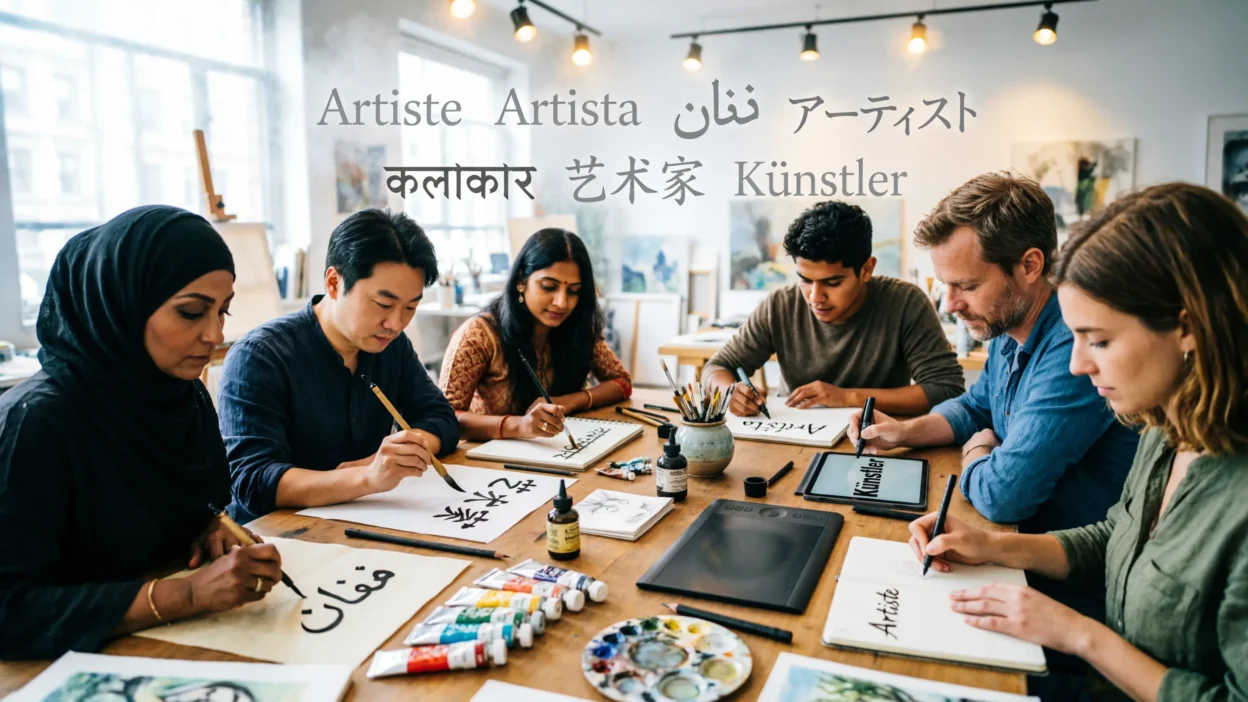
Art is a universal language that connects people across cultures, countries, and generations.
If someone paints, sings, dances, sculpts, or creates digital designs, the word “artist” carries deep meaning everywhere in the world.
Learning how to say “artist” in different languages is not only fun but also useful for travelers, students, language learners, and creative professionals.
Understanding global translations helps people appreciate cultural diversity and communicate more effectively.
From Europe to Asia and Africa to the Americas, every language has its own unique way of expressing creativity and artistic identity.
In this guide, you will discover 30 translations of the word “artist” along with meanings, explanations, and practical lessons.
1. Artist in Spanish
Verse or Statement: “Artista”
Meaning
In Spanish, the word for artist is “artista.” It is commonly used for painters, musicians, actors, and performers. The word sounds elegant and reflects the strong artistic traditions found in Spanish-speaking countries.
Lesson
Creativity is celebrated in every culture and language.
2. Artist in French
Verse or Statement: “Artiste”
Meaning
French uses the word “artiste” for artist. France has a rich history of art, fashion, and literature, making this word deeply connected to creativity and culture. It is often associated with elegance and sophistication.
Lesson
Art can represent beauty and cultural identity.
3. Artist in German
Verse or Statement: “Künstler”
Meaning
In German, “Künstler” refers to an artist or creative person. The term can describe painters, musicians, and performers alike. Germany’s strong artistic and musical heritage gives this word special significance.
Lesson
Creative talent can inspire entire generations.
4. Artist in Italian
Verse or Statement: “Artista”
Meaning
Italian uses the same word as Spanish: “artista.” Italy is famous for Renaissance art, making this translation closely linked with history, painting, and sculpture. It symbolizes artistic excellence.
Lesson
Great art leaves a lasting legacy.
5. Artist in Portuguese
Verse or Statement: “Artista”
Meaning
In Portuguese-speaking countries, “artista” is used for all kinds of creative individuals. It often refers to musicians and entertainers as well as painters and designers.
Lesson
Art takes many forms and expressions.
6. Artist in Arabic
Verse or Statement: “فنان” (Fannan)
Meaning
The Arabic word “فنان” means artist and often describes someone skilled in creativity or performance. Arabic art traditions include calligraphy, poetry, music, and architecture.
Lesson
Art reflects both tradition and imagination.
7. Artist in Chinese
Verse or Statement: “艺术家” (Yìshùjiā)
Meaning
In Chinese, “艺术家” translates directly to artist or art expert. The word combines the ideas of art and mastery. Chinese culture highly values painting, music, and creative craftsmanship.
Lesson
Mastery comes through dedication and practice.
8. Artist in Japanese
Verse or Statement: “アーティスト” (Ātisuto)
Meaning
Japanese often uses the borrowed English-style term “アーティスト.” It is commonly used in music, painting, and entertainment industries. Japan’s modern and traditional arts both influence this word.
Lesson
Languages evolve by adopting global influences.
9. Artist in Korean
Verse or Statement: “예술가” (Yesulga)
Meaning
The Korean word “예술가” refers to a person involved in artistic activities. It highlights creativity and cultural contribution. Korean music and visual arts have made this term globally recognized.
Lesson
Art can connect local culture with the world.
10. Artist in Russian
Verse or Statement: “Художник” (Khudozhnik)
Meaning
Russian uses “Художник” mainly for painters and visual artists. Russia has a strong artistic heritage in literature, ballet, and painting, giving this term cultural importance.
Lesson
Art preserves national history and emotion.
11. Artist in Hindi
Verse or Statement: “कलाकार” (Kalakar)
Meaning
In Hindi, “कलाकार” means artist or performer. It is widely used in India for actors, dancers, singers, and painters. The word emphasizes talent and creativity.
Lesson
Every creative skill deserves appreciation.
12. Artist in Urdu
Verse or Statement: “فنکار” (Fankaar)
Meaning
The Urdu word “فنکار” refers to a talented artist or performer. It is often associated with poetry, music, and acting in South Asian culture.
Lesson
Art speaks directly to human emotions.
13. Artist in Turkish
Verse or Statement: “Sanatçı”
Meaning
“Sanatçı” is the Turkish translation for artist. The word comes from “sanat,” meaning art. It describes anyone involved in creative work or performance.
Lesson
Creativity adds value to society.
14. Artist in Greek
Verse or Statement: “Καλλιτέχνης” (Kallitéchnis)
Meaning
Greek uses “Καλλιτέχνης” for artist, meaning someone skilled in beautiful arts. Ancient Greek culture heavily influenced modern artistic ideas.
Lesson
Art has shaped civilization for centuries.
15. Artist in Dutch
Verse or Statement: “Artiest”
Meaning
The Dutch word “artiest” is often used for performers and entertainers. It highlights creativity in music, theater, and visual arts.
Lesson
Performance art can unite audiences everywhere.
16. Artist in Polish
Verse or Statement: “Artysta”
Meaning
In Polish, “artysta” refers to creative professionals in any artistic field. The word sounds similar to English because of shared Latin roots.
Lesson
Languages often share common artistic expressions.
17. Artist in Swedish
Verse or Statement: “Konstnär”
Meaning
The Swedish word “konstnär” mainly describes visual artists such as painters and sculptors. Scandinavian art is known for simplicity and elegance.
Lesson
Simple creativity can have powerful impact.
18. Artist in Norwegian
Verse or Statement: “Kunstner”
Meaning
Norwegian uses “kunstner” for artist. The term reflects artistic skill and originality in visual and performing arts.
Lesson
Original ideas help art stand out.
19. Artist in Danish
Verse or Statement: “Kunstner”
Meaning
Like Norwegian, Danish uses “kunstner.” It is a respected term for anyone who creates meaningful artistic work.
Lesson
Creative work deserves recognition and respect.
20. Artist in Finnish
Verse or Statement: “Taiteilija”
Meaning
“Taiteilija” is the Finnish word for artist. Finland’s artistic traditions include music, design, and architecture.
Lesson
Art often reflects a nation’s environment and culture.
21. Artist in Thai
Verse or Statement: “ศิลปิน” (Silapin)
Meaning
In Thai, “ศิลปิน” means artist and is used for musicians, actors, and creators. Thai culture values decorative arts and traditional performances.
Lesson
Art keeps traditions alive for future generations.
22. Artist in Vietnamese
Verse or Statement: “Nghệ sĩ”
Meaning
The Vietnamese word “nghệ sĩ” commonly refers to performers and artists. It represents skill, creativity, and cultural contribution.
Lesson
Creative expression strengthens cultural identity.
23. Artist in Indonesian
Verse or Statement: “Seniman”
Meaning
“Seniman” is the Indonesian term for artist. It is used for people involved in painting, music, dance, and crafts.
Lesson
Art thrives in diverse cultural traditions.
24. Artist in Malay
Verse or Statement: “Artis”
Meaning
In Malay, “artis” often refers to entertainers and celebrities, though it can also mean artist generally. The word is simple and easy to recognize.
Lesson
Modern language is shaped by media and culture.
25. Artist in Hebrew
Verse or Statement: “אמן” (Oman)
Meaning
Hebrew uses “אמן” for artist or craftsman. The word can also suggest mastery and dedication to creative work.
Lesson
True artistry requires commitment and passion.
26. Artist in Swahili
Verse or Statement: “Msanii”
Meaning
The Swahili word “msanii” refers to an artist, performer, or creative individual. East African music and storytelling traditions give this term cultural richness.
Lesson
Storytelling is one of humanity’s oldest arts.
27. Artist in Bengali
Verse or Statement: “শিল্পী” (Shilpi)
Meaning
In Bengali, “শিল্পী” means artist or performer. Bengali literature and music have contributed greatly to South Asian culture.
Lesson
Art can preserve language and heritage.
28. Artist in Punjabi
Verse or Statement: “ਕਲਾਕਾਰ” (Kalakar)
Meaning
Punjabi uses “ਕਲਾਕਾਰ” for artist or performer. Punjabi music and dance traditions make this term widely recognized in entertainment.
Lesson
Music and dance bring communities together.
29. Artist in Latin
Verse or Statement: “Artifex”
Meaning
The Latin word “artifex” originally meant craftsman or skilled creator. Many modern artistic terms come from Latin roots.
Lesson
Ancient languages still influence modern vocabulary.
30. Artist in Filipino
Verse or Statement: “Alagad ng Sining”
Meaning
In Filipino, this phrase means “servant of art.” It is a respectful term for someone devoted to creativity and artistic expression.
Lesson
Art is both talent and service to society.
FAQ:
1. How do you say artist in most European languages?
Many European languages use similar words such as “artista,” “artiste,” or “artysta.” These similarities come from shared Latin roots connected to art and creativity.
2. What is the Arabic word for artist?
The Arabic word for artist is “فنان” (Fannan). It describes someone involved in creative arts like music, painting, or performance.
3. Why are some translations similar to English?
Many languages borrow words from Latin, French, or English. This is why terms like “artist,” “artiste,” and “artista” sound alike.
4. What language uses the word “Künstler”?
German uses the word “Künstler” for artist. It commonly refers to painters, musicians, actors, and creative professionals.
5. Is the word artist used only for painters?
No, the word artist can describe musicians, dancers, actors, writers, and digital creators as well. It applies to anyone expressing creativity through a skill or medium.
6. Why is learning words in different languages useful?
Learning translations improves communication and cultural understanding. It also helps travelers, students, and creators connect with international audiences.
7. What is the Japanese word for artist?
Japanese commonly uses “アーティスト” (Ātisuto), which is adapted from the English word “artist.” Traditional Japanese terms may also describe specific art forms.
8. Which cultures value art the most?
Almost every culture values art in unique ways. From ancient Greek sculptures to modern Korean music, art remains an important part of human expression worldwide.
Final Thoughts
Learning how to say “artist” in different languages is a fascinating way to explore world cultures and creative traditions.
Every translation carries unique history, emotion, and artistic identity that reflects the values of its people.
If you are a language learner, traveler, student, or creative professional, these translations can help you better appreciate global diversity.
Art continues to connect humanity across borders, proving that creativity truly is a universal language.