
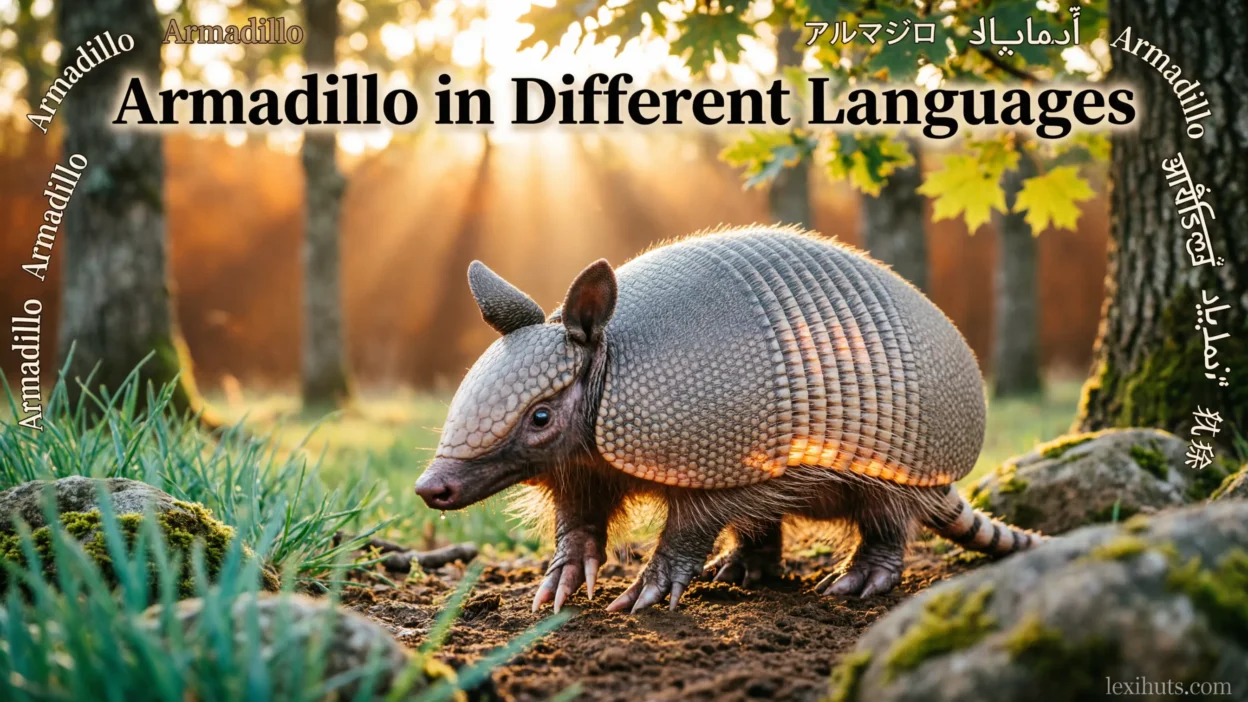
Language connects people, cultures, and ideas in fascinating ways.
Learning how to say “armadillo” in different languages is a fun way to explore global communication while also discovering how different cultures describe this unique animal.
If you are a language learner, traveler, student, or content creator, understanding animal names in multiple languages can improve vocabulary and cultural awareness.
The armadillo is known for its protective shell and unusual appearance, making it one of the most recognizable animals in the world.
Because this animal exists mainly in the Americas, many languages have interesting translations or descriptions for it.
In this article, you will discover 30 ways to say “armadillo” in different languages, along with meanings, cultural insights, and practical lessons that make learning enjoyable and memorable.
1. English – Armadillo
Verse or Statement:
In English, the word is “Armadillo.”
Meaning:
The English term comes from Spanish and refers to the animal’s armored shell. Armadillos are famous for their protective covering and burrowing habits. The word has become widely recognized in science, education, and wildlife discussions.
Lesson:
Many English words originate from other languages and cultures.
2. Spanish – Armadillo
Verse or Statement:
In Spanish, “Armadillo” means “little armored one.”
Meaning:
The name comes from the Spanish word “armado,” meaning armored. Spanish-speaking countries in Latin America commonly use this term because armadillos are native to the region. The name perfectly describes the animal’s hard outer shell.
Lesson:
Descriptive names often reflect an animal’s physical features.
3. French – Tatou
Verse or Statement:
The French word for armadillo is “Tatou.”
Meaning:
French uses a short and simple word that sounds elegant and easy to pronounce. The term is commonly used in books, zoos, and educational materials. It shows how languages simplify foreign animal names over time.
Lesson:
Simple vocabulary can make language learning easier.
4. German – Gürteltier
Verse or Statement:
In German, armadillo is called “Gürteltier.”
Meaning:
This word translates roughly to “belt animal.” Germans describe the shell bands around the animal’s body like belts. The name highlights the armadillo’s unusual appearance in a creative way.
Lesson:
Different cultures notice different traits in animals.
5. Italian – Armadillo
Verse or Statement:
Italian also uses the word “Armadillo.”
Meaning:
Italian borrowed the name from Spanish, much like English did. The word is easy for Italian speakers to recognize and pronounce. It reflects how languages often share vocabulary through history and trade.
Lesson:
Languages frequently borrow words from one another.
6. Portuguese – Tatu
Verse or Statement:
In Portuguese, the word is “Tatu.”
Meaning:
Brazilian Portuguese commonly uses this shorter form. Since armadillos are common in parts of Brazil, the word is familiar in everyday speech and wildlife discussions. It is one of the most recognized animal names in South America.
Lesson:
Local wildlife strongly influences language.
7. Dutch – Gordeldier
Verse or Statement:
The Dutch translation is “Gordeldier.”
Meaning:
This word means “belt animal,” similar to German. Dutch speakers focus on the armored bands around the armadillo’s body. The term paints a vivid picture of the creature’s appearance.
Lesson:
Visual descriptions help people remember vocabulary.
8. Russian – Броненосец (Bronenosets)
Verse or Statement:
In Russian, armadillo is “Bronenosets.”
Meaning:
The word means “armored carrier.” Russians compare the animal to armor because of its protective shell. The term sounds powerful and reflects strength and defense.
Lesson:
Animal names can symbolize protection and resilience.
9. Chinese – 犰狳 (Qiúyú)
Verse or Statement:
The Chinese word for armadillo is “Qiúyú.”
Meaning:
This term is mainly used in scientific and educational contexts. Chinese characters often carry historical and descriptive meanings. The word represents how Chinese language preserves unique animal classifications.
Lesson:
Learning foreign scripts expands cultural understanding.
10. Japanese – アルマジロ (Arumajiro)
Verse or Statement:
Japanese uses “Arumajiro.”
Meaning:
This is a phonetic adaptation of the original word “armadillo.” Japanese often uses katakana characters for foreign terms. The pronunciation makes the word easier for native speakers.
Lesson:
Languages adapt foreign words to match local pronunciation.
11. Korean – 아르마딜로 (Areumadillo)
Verse or Statement:
The Korean translation is “Areumadillo.”
Meaning:
Korean transliterates the English or Spanish pronunciation into Hangul characters. The word is mainly found in zoos, science books, and documentaries.
Lesson:
Modern languages often adopt global vocabulary directly.
12. Arabic – أرماديلو (Armadيلو)
Verse or Statement:
Arabic speakers say “Armadيلو.”
Meaning:
The Arabic version keeps the original sound while fitting Arabic writing patterns. The word is commonly used in educational contexts about wildlife.
Lesson:
Language adapts while preserving meaning.
13. Hindi – आर्माडिलो (Aarmadilo)
Verse or Statement:
In Hindi, the word is “Aarmadilo.”
Meaning:
Hindi speakers use a transliterated form because armadillos are not native to India. The word mainly appears in schools, wildlife studies, and international media.
Lesson:
Not all animals exist naturally in every country.
14. Urdu – آرماڈیلو (Armadيلو)
Verse or Statement:
Urdu uses “Armadيلو.”
Meaning:
Like Hindi, Urdu borrows the original pronunciation. The word is mainly used in educational discussions and documentaries.
Lesson:
Borrowed words enrich language diversity.
15. Turkish – Armadillo
Verse or Statement:
The Turkish word is also “Armadillo.”
Meaning:
Turkish adopts the international form of the word. This helps maintain consistency in scientific and wildlife communication.
Lesson:
Global communication encourages shared vocabulary.
16. Greek – Αρμαντίλο (Armantilo)
Verse or Statement:
Greek translates armadillo as “Armantilo.”
Meaning:
The Greek spelling adapts the pronunciation into the Greek alphabet. The term is mostly used in academic and zoological settings.
Lesson:
Alphabets shape the sound of foreign words.
17. Polish – Pancernik
Verse or Statement:
In Polish, armadillo is “Pancernik.”
Meaning:
The word means “armored one” or “tank.” Polish emphasizes the strong shell and defensive nature of the animal.
Lesson:
Animal names can reflect strength and survival.
18. Swedish – Bältdjur
Verse or Statement:
Swedish speakers call it “Bältdjur.”
Meaning:
The term translates to “belt animal.” The shell bands inspire the name, similar to Germanic languages.
Lesson:
Related languages often share naming patterns.
19. Danish – Bæltedyr
Verse or Statement:
In Danish, the word is “Bæltedyr.”
Meaning:
This also means “belt animal.” Scandinavian languages often use descriptive naming systems for animals.
Lesson:
Descriptions make vocabulary easier to visualize.
20. Norwegian – Beltedyr
Verse or Statement:
Norwegian uses “Beltedyr.”
Meaning:
Like Danish and Swedish, the word refers to the shell-like bands. The term reflects the animal’s unique body structure.
Lesson:
Nature inspires creative language development.
21. Finnish – Vyötiäinen
Verse or Statement:
The Finnish translation is “Vyötiäinen.”
Meaning:
This word relates to belts or bands around the body. Finnish vocabulary often creates highly descriptive animal names.
Lesson:
Descriptive language improves memory and understanding.
22. Czech – Pásovec
Verse or Statement:
Czech speakers say “Pásovec.”
Meaning:
The word highlights the striped or banded appearance of the shell. It is commonly used in zoological references.
Lesson:
Animal features often inspire local terminology.
23. Hungarian – Tatú
Verse or Statement:
In Hungarian, armadillo is “Tatú.”
Meaning:
The word closely resembles Portuguese “Tatu.” It demonstrates how animal names spread across regions and languages.
Lesson:
Some words travel internationally with very little change.
24. Romanian – Armadillo
Verse or Statement:
Romanian uses the international form “Armadillo.”
Meaning:
The borrowed term helps Romanian speakers recognize the animal in global discussions and media.
Lesson:
Shared vocabulary supports international learning.
25. Thai – ตัวนิ่มเกราะ (Tua Nim Kroh)
Verse or Statement:
Thai describes the armadillo as “armored soft animal.”
Meaning:
The name reflects the creature’s appearance and shell structure. Thai often combines descriptive words to form animal names.
Lesson:
Compound words create vivid meanings.
26. Vietnamese – Con Tê Tê Bọc Giáp
Verse or Statement:
Vietnamese uses a phrase meaning “armored pangolin-like animal.”
Meaning:
Because armadillos are unfamiliar in Vietnam, the language compares them to similar creatures. This helps people understand the animal quickly.
Lesson:
People explain unfamiliar things using familiar comparisons.
27. Indonesian – Armadillo
Verse or Statement:
Indonesian speakers also say “Armadillo.”
Meaning:
The international term is widely accepted in Indonesian wildlife vocabulary. The pronunciation is adjusted slightly for local speech patterns.
Lesson:
Global media influences modern language.
28. Malay – Armadillo
Verse or Statement:
Malay uses “Armadillo.”
Meaning:
The word is common in educational materials and wildlife references. It reflects international scientific communication.
Lesson:
Science often creates universal language connections.
29. Swahili – Kakakuona Mwenye Ngao
Verse or Statement:
A descriptive Swahili phrase means “small animal with a shield.”
Meaning:
Swahili often uses descriptive naming methods for unfamiliar animals. The shield comparison perfectly matches the armadillo’s shell.
Lesson:
Descriptions help bridge language and culture.
30. Latin – Dasypus
Verse or Statement:
The scientific Latin name related to armadillos is “Dasypus.”
Meaning:
Latin names are used in biology for classification and scientific research. This term helps scientists worldwide identify the species accurately.
Lesson:
Scientific names create universal understanding.
FAQ
1. What does the word “armadillo” mean?
The word “armadillo” comes from Spanish and means “little armored one.” It refers to the animal’s protective shell-like covering. The name perfectly describes its appearance.
2. Which language originally used the word armadillo?
Spanish is the original language associated with the word “armadillo.” The term later spread into English and many other languages because the animal is native to Latin America.
3. Why do many languages describe the armadillo as a belt animal?
Many European languages focus on the shell bands around the animal’s body. These bands look similar to belts, which inspired names like the German “Gürteltier” and Dutch “Gordeldier.”
4. Is the armadillo found worldwide?
No, armadillos mainly live in the Americas, especially South and Central America. Because they are not native to many countries, some languages simply borrow the Spanish or English word.
5. Why do some languages use the same word for armadillo?
Global communication, science, and media encourage languages to adopt international terms. Using the same word also makes wildlife education easier across countries.
6. What is the scientific name for armadillo?
One scientific classification related to armadillos is “Dasypus.” Scientists use Latin names to ensure accurate identification worldwide.
7. Are armadillos dangerous to humans?
Armadillos are generally shy and harmless animals. They usually avoid humans and spend most of their time digging or searching for food.
8. Why is learning animal names in different languages useful?
Learning animal names improves vocabulary, cultural understanding, and communication skills. It also helps travelers, students, and language learners connect with people globally.
Final Thoughts
Learning how to say “armadillo” in different languages is more than just memorizing words.
It opens the door to understanding culture, communication, and the creative ways people describe the natural world.
From “belt animal” in Germanic languages to “little armored one” in Spanish, each translation tells a unique story.
If you are studying languages, creating educational content, or simply exploring global vocabulary, these translations can help you appreciate linguistic diversity.
Keep learning new words from around the world, because every language offers a fresh perspective on life and nature.