
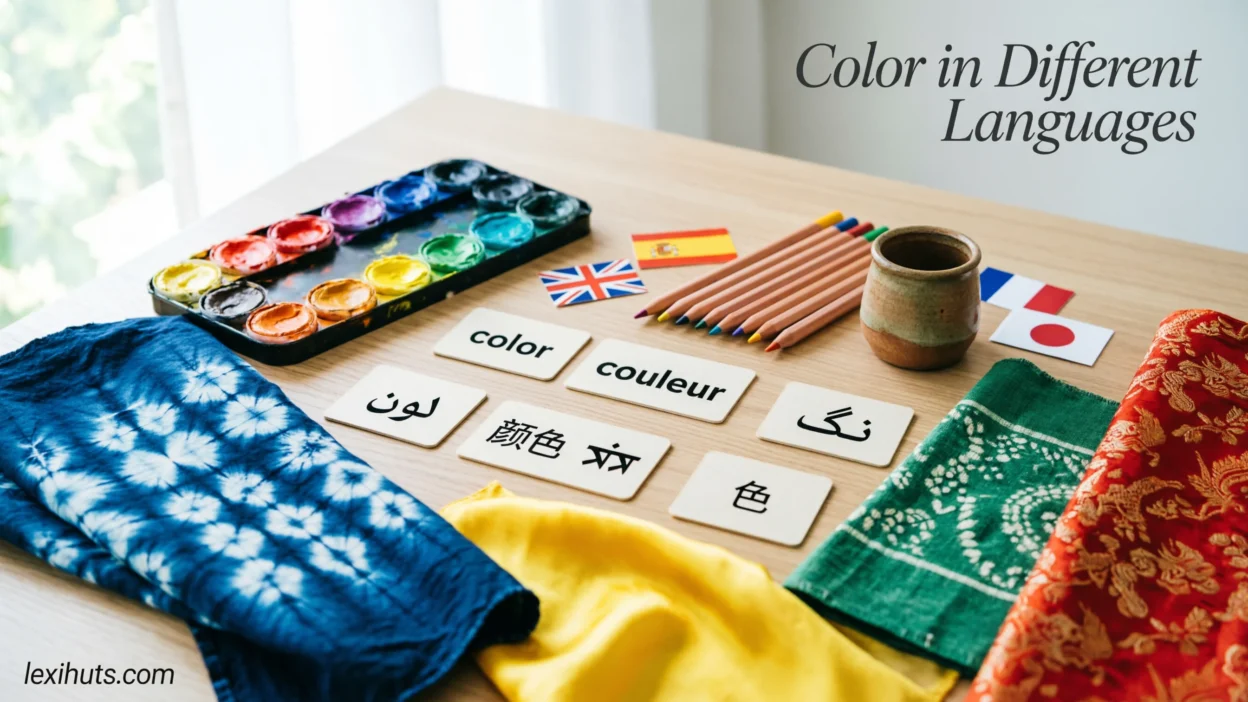
Colors are an important part of communication, culture, art, fashion, and daily life.
Learning how to say “color” in different languages can help travelers, students, language learners, and culture enthusiasts connect with people worldwide. It also improves vocabulary and understanding of global cultures.
In many languages, the word for color carries cultural meaning and unique pronunciation patterns.
If you are studying a new language, creating multilingual content, or simply curious about global translations, this guide will help you discover how “color” is expressed around the world.
What Does “Color” Mean?
The word “color” refers to the appearance of objects based on the way they reflect light. It is commonly used in art, design, education, fashion, and everyday conversation.
Common Uses of the Word Color
- Talking about clothing and fashion
- Describing nature and art
- Learning vocabulary in foreign languages
- Teaching children colors and language basics
- Creating multilingual educational content
Color in Different Languages
1. Color in Spanish
Phrase: Color
Pronunciation: Koh-lor
Meaning: Used for colors in art, clothing, and everyday speech.
Example: Me gusta el color azul.
2. Color in French
Phrase: Couleur
Pronunciation: Koo-lur
Meaning: Refers to shades and visual appearance.
Example: Quelle est ta couleur préférée?
3. Color in German
Phrase: Farbe
Pronunciation: Far-buh
Meaning: Common German word for color.
Example: Die Farbe Rot ist schön.
4. Color in Italian
Phrase: Colore
Pronunciation: Koh-lo-reh
Meaning: Used in design, fashion, and daily language.
Example: Il colore verde è rilassante.
5. Color in Portuguese
Phrase: Cor
Pronunciation: Kor
Meaning: Popular term used in Portugal and Brazil.
Example: Qual é sua cor favorita?
6. Color in Dutch
Phrase: Kleur
Pronunciation: Klur
Meaning: Dutch word commonly used for shades and tones.
Example: Mijn favoriete kleur is blauw.
7. Color in Russian
Phrase: Цвет
Pronunciation: Tsvyet
Meaning: Refers to all types of colors and tones.
Example: Мне нравится этот цвет.
8. Color in Chinese
Phrase: 颜色
Pronunciation: Yan-seh
Meaning: Standard Mandarin term for color.
Example: 我喜欢红色。
9. Color in Japanese
Phrase: 色
Pronunciation: Ee-roh
Meaning: Basic Japanese word for color.
Example: 好きな色は青です。
10. Color in Korean
Phrase: 색깔
Pronunciation: Saek-kal
Meaning: Frequently used in Korean conversations.
Example: 이 색깔이 예뻐요.
11. Color in Arabic
Phrase: لون
Pronunciation: Lawn
Meaning: Used widely in Middle Eastern countries.
Example: ما هو لونك المفضل؟
12. Color in Hindi
Phrase: रंग
Pronunciation: Rang
Meaning: Common Hindi term for color and shades.
Example: मुझे लाल रंग पसंद है।
13. Color in Urdu
Phrase: رنگ
Pronunciation: Rang
Meaning: Used in Pakistan and Urdu-speaking communities.
Example: مجھے نیلا رنگ پسند ہے۔
14. Color in Turkish
Phrase: Renk
Pronunciation: Renk
Meaning: Turkish word for all visual colors.
Example: En sevdiğim renk siyah.
15. Color in Greek
Phrase: Χρώμα
Pronunciation: Hro-ma
Meaning: Used in Greek art and conversation.
Example: Το αγαπημένο μου χρώμα είναι το μπλε.
16. Color in Polish
Phrase: Kolor
Pronunciation: Koh-lor
Meaning: Polish translation for color.
Example: Lubię ten kolor.
17. Color in Swedish
Phrase: Färg
Pronunciation: Fairg
Meaning: Common Scandinavian term for color.
Example: Vilken färg gillar du?
18. Color in Norwegian
Phrase: Farge
Pronunciation: Far-guh
Meaning: Used in everyday Norwegian language.
Example: Jeg liker denne fargen.
19. Color in Danish
Phrase: Farve
Pronunciation: Far-vuh
Meaning: Danish word for colors and shades.
Example: Hvad er din yndlingsfarve?
20. Color in Finnish
Phrase: Väri
Pronunciation: Vaa-ri
Meaning: Finnish translation for color.
Example: Mikä on lempivärisi?
21. Color in Thai
Phrase: สี
Pronunciation: See
Meaning: Common Thai word used for all colors.
Example: ฉันชอบสีแดง
22. Color in Vietnamese
Phrase: Màu sắc
Pronunciation: Mau Sak
Meaning: Vietnamese expression for color.
Example: Tôi thích màu xanh.
23. Color in Indonesian
Phrase: Warna
Pronunciation: War-na
Meaning: Widely used Indonesian word for color.
Example: Warna favorit saya biru.
24. Color in Malay
Phrase: Warna
Pronunciation: War-na
Meaning: Malay translation for color.
Example: Saya suka warna merah.
25. Color in Hebrew
Phrase: צבע
Pronunciation: Tseh-vah
Meaning: Hebrew term for colors and shades.
Example: מה הצבע האהוב עליך?
26. Color in Bengali
Phrase: রং
Pronunciation: Rong
Meaning: Common Bengali word for color.
Example: আমি নীল রং পছন্দ করি।
27. Color in Punjabi
Phrase: ਰੰਗ
Pronunciation: Rang
Meaning: Punjabi word commonly used in daily speech.
Example: ਮੈਨੂੰ ਲਾਲ ਰੰਗ ਪਸੰਦ ਹੈ।
28. Color in Tamil
Phrase: நிறம்
Pronunciation: Ni-ram
Meaning: Tamil term for color and appearance.
Example: எனக்கு நீல நிறம் பிடிக்கும்.
29. Color in Telugu
Phrase: రంగు
Pronunciation: Rangu
Meaning: Telugu word for shades and colors.
Example: నాకు ఎరుపు రంగు ఇష్టం.
30. Color in Marathi
Phrase: रंग
Pronunciation: Rang
Meaning: Frequently used Marathi word for color.
Example: मला निळा रंग आवडतो.
31. Color in Swahili
Phrase: Rangi
Pronunciation: Ran-gee
Meaning: Swahili translation for color.
Example: Ninapenda rangi ya kijani.
32. Color in Filipino
Phrase: Kulay
Pronunciation: Koo-lai
Meaning: Filipino word for color.
Example: Anong paborito mong kulay?
33. Color in Czech
Phrase: Barva
Pronunciation: Bar-va
Meaning: Czech word used for describing colors.
Example: Moje oblíbená barva je modrá.
34. Color in Romanian
Phrase: Culoare
Pronunciation: Koo-lo-ah-reh
Meaning: Romanian translation for color.
Example: Îmi place această culoare.
35. Color in Ukrainian
Phrase: Колір
Pronunciation: Koh-leer
Meaning: Ukrainian term for visual colors.
Example: Мій улюблений колір синій.
Why Learning Color in Different Languages Is Important
Learning color names and translations improves communication skills and helps people understand different cultures. It is especially useful for travelers, students, teachers, artists, designers, and multilingual content creators.
Knowing how to say color in multiple languages also improves memory, pronunciation skills, and cultural awareness. It can make conversations more engaging and help language learners expand their vocabulary quickly.
Useful Tips for Learning Colors in Multiple Languages
Practice Pronunciation Daily
Repeat the words aloud to improve speaking confidence and listening skills.
Use Flashcards
Create visual flashcards with color names and translations to memorize faster.
Watch Foreign Language Videos
Listening to native speakers helps improve pronunciation and understanding.
Learn Basic Color Names First
Start with simple colors like red, blue, green, black, and white before advanced shades.
Practice With Native Sentences
Reading example sentences helps you understand real-world usage.
Conclusion
Learning how to say “color” in different languages is a fun and useful way to expand your vocabulary and understand global cultures.
From Spanish and French to Chinese and Arabic, every language has its own unique pronunciation and expression.
If you are traveling, studying languages, or creating multilingual content, these translations can help you communicate more effectively around the world.
FAQs
1. How do you say color in Spanish?
The word for color in Spanish is “Color,” pronounced as Koh-lor.
2. What is the Japanese word for color?
In Japanese, color is written as “色” and pronounced “Ee-roh.”
3. Why should I learn color names in different languages?
Learning color names improves vocabulary, communication skills, and cultural understanding.
4. Is the word color similar in many languages?
Yes, many languages such as Spanish, Italian, and Polish use similar words derived from Latin roots.
5. Which language uses the word “Rang” for color?
Hindi, Urdu, Punjabi, and Marathi commonly use the word “Rang” for color.