
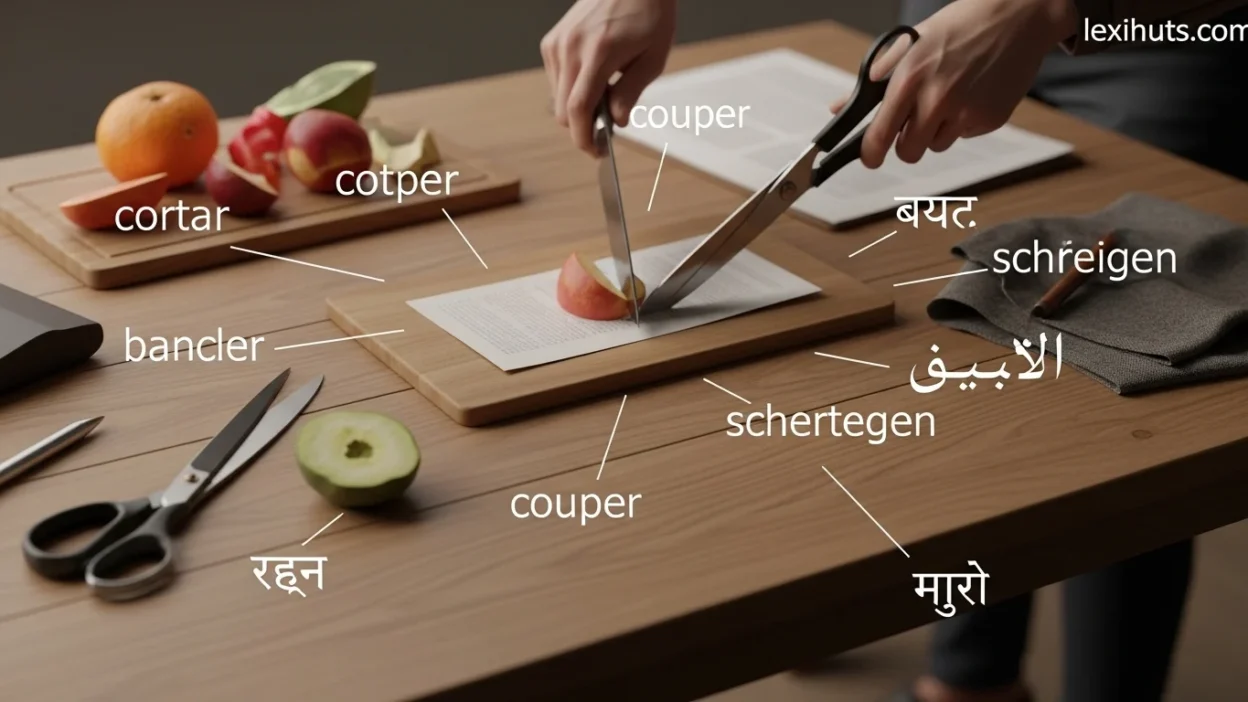
Understanding how to say “cut in different languages” is useful for travel, communication, language learning, and everyday conversations.
If you’re talking about cutting food, trimming hair, or describing an action, this simple word appears in many real-life situations.
In this guide, you’ll discover translations, pronunciations, and examples across popular languages in a clear, easy-to-follow format.
What Does “Cut” Mean?
The word “cut” generally refers to separating something using a sharp tool, reducing size, or making an incision. Its meaning can slightly change depending on context, such as cooking, editing, or physical actions.
Cut in Different Languages (Top Translations)
1. Spanish
Phrase: Cortar
Pronunciation: kor-tar
Example: Voy a cortar la fruta.
Meaning: To slice or divide something with a tool
2. French
Phrase: Couper
Pronunciation: koo-pay
Example: Je vais couper le pain.
Meaning: To cut or break apart
3. German
Phrase: Schneiden
Pronunciation: shny-den
Example: Ich schneide das Gemüse.
Meaning: To cut or slice
4. Italian
Phrase: Tagliare
Pronunciation: tal-ya-re
Example: Taglio il pane.
Meaning: To cut into pieces
5. Portuguese
Phrase: Cortar
Pronunciation: kor-tar
Example: Vou cortar o bolo.
Meaning: To cut or trim
6. Dutch
Phrase: Snijden
Pronunciation: sny-den
Example: Ik snijd het brood.
Meaning: To slice or cut
7. Russian
Phrase: Резать (Rezat’)
Pronunciation: re-zat
Example: Я режу хлеб.
Meaning: To cut or chop
8. Arabic
Phrase: يقطع (Yaqta’)
Pronunciation: yak-ta
Example: يقطع اللحم
Meaning: To cut or separate
9. Hindi
Phrase: काटना (Kaatna)
Pronunciation: kaat-na
Example: मैं फल काटता हूँ।
Meaning: To cut or divide
10. Urdu
Phrase: کاٹنا (Kaatna)
Pronunciation: kaat-na
Example: وہ سبزی کاٹ رہا ہے۔
Meaning: To cut or slice
11. Chinese (Mandarin)
Phrase: 切 (Qiē)
Pronunciation: chieh
Example: 我切水果。
Meaning: To cut or slice
12. Japanese
Phrase: 切る (Kiru)
Pronunciation: kee-roo
Example: 野菜を切る
Meaning: To cut with a blade
13. Korean
Phrase: 자르다 (Jareuda)
Pronunciation: ja-reu-da
Example: 음식을 자르다
Meaning: To cut or trim
14. Turkish
Phrase: Kesmek
Pronunciation: kes-mek
Example: Ekmeği kesiyorum.
Meaning: To cut or slice
15. Greek
Phrase: Κόβω (Kovo)
Pronunciation: ko-vo
Example: Κόβω το ψωμί.
Meaning: To cut or chop
Common Uses of “Cut” in Daily Life
Cutting Food
Used while cooking or preparing meals, such as slicing vegetables or fruits.
Cutting Hair
Refers to trimming or styling hair.
Cutting Paper
Common in school or office tasks.
Cutting Costs
Used figuratively to mean reducing expenses.
Variations and Related Words
Slice
A thinner, more precise cut, often used for food.
Chop
A stronger cutting action, usually with force.
Trim
A light or neat cut, often for hair or edges.
Slash
A quick and forceful cut.
Why Learning “Cut in Different Languages” Is Important
Learning how to say basic action words like “cut” in multiple languages helps improve communication skills and builds vocabulary faster. It is especially useful for travelers, students, and professionals working in international environments. Knowing such verbs also makes conversations more natural and practical.
Practical Tips to Remember These Translations
Use Daily Practice
Repeat each word while performing the action to build memory.
Learn with Context
Associate the word with real-life situations like cooking or crafting.
Focus on Pronunciation
Say the words out loud to improve fluency.
Group Similar Languages
Notice patterns in similar languages like Spanish and Portuguese.
Use Flashcards
Create quick revision tools to remember faster.
Conclusion
Understanding “cut in different languages” is a simple yet powerful way to enhance your vocabulary and communication skills.
These translations help you interact confidently in various situations, whether you’re traveling, learning, or working.
Start practicing today and make these words part of your everyday language use.
FAQs:
1. What is the most common translation of “cut”?
The most common translations include “cortar” in Spanish and “couper” in French.
2. Is “cut” used differently in different languages?
Yes, the meaning can vary slightly depending on context like food, hair, or figurative use.
3. How can I remember “cut” in multiple languages?
Practice daily, use examples, and associate the word with actions.
4. Are there multiple words for “cut” in one language?
Yes, some languages have different words depending on the type of cutting action.
5. Why should I learn basic verbs like “cut”?
They are essential for everyday communication and help build a strong language foundation.